







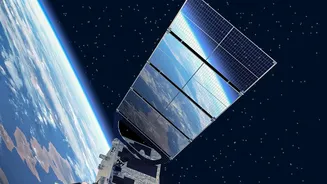
A Landmark Earth-Sensing Mission
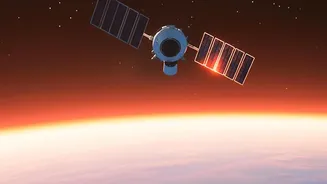
The most significant joint project to date is the NISAR (NASA-ISRO Synthetic Aperture Radar) satellite, which launched in July 2025. Hailed as a major civil-space collaboration, this $1.5 billion mission is the first satellite jointly developed by the two
agencies. It uniquely combines NASA’s L-band and ISRO’s S-band radar systems to map the entire globe every 12 days. This provides an unparalleled, all-weather view of Earth's surface. For India, the benefits are immense. NISAR's data will be crucial for managing natural disasters like earthquakes and floods, improving agricultural monitoring, and tracking climate change impacts on glaciers and forests. This flow of critical data enhances India’s ability to make informed policy decisions on climate resilience and food security.
Gateway to Human Spaceflight
The partnership is proving vital for India's ambitious Gaganyaan program, which aims to send Indian astronauts into orbit. As part of the collaboration, Indian astronaut-designates have been training at NASA's Johnson Space Center in Houston. This hands-on experience is invaluable, preparing the crew for long-duration missions and complex operations. A joint mission to the International Space Station (ISS) has also been agreed upon, which will see an Indian astronaut fly to the station. This mission serves as a crucial stepping stone, providing ISRO with firsthand experience in human spaceflight operations before it launches its own crewed missions. The collaboration helps bridge technological gaps and aligns India's human spaceflight protocols with international standards, ensuring greater safety and interoperability.
Joining the Lunar Exploration Club
India's signing of the Artemis Accords in 2023 was a pivotal moment, signaling its commitment to a US-led framework for cooperative lunar exploration. This move integrates ISRO into a global coalition focused on returning humans to the Moon and establishing a sustainable presence. More recently, in August 2026, NASA formally invited ISRO to participate in its Moon Base program. This invitation is a direct result of India's demonstrated success with the Chandrayaan missions, particularly the historic landing near the lunar south pole. Participation provides India access to shared data, advanced technologies, and a role in shaping the future of lunar infrastructure, accelerating its own deep-space exploration goals.
Strategic and Commercial Frontiers
Beyond the scientific gains, the space partnership holds significant geopolitical and economic weight. The collaboration is widely seen as a strategic alignment to counterbalance China's growing influence in space. By joining the US-led alliance, India positions itself as a key player in shaping the norms of space governance. This enhanced cooperation, formalized under initiatives like iCET and TRUST, also eases access to critical American space technology and components for Indian firms. It opens up new avenues for India's burgeoning private space sector, which now includes over 400 startups. The partnership is expected to drive commercial collaborations in satellite services, launch systems, and space manufacturing, boosting India’s space economy, which is projected to reach $44 billion by 2033.