




First, Let's Define 'Day' and 'Year'
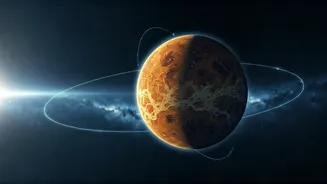
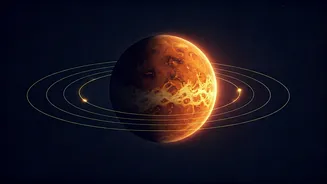
Before we dive into the 'why,' we need to be clear about what we mean. For Earth, it’s simple: a day is one rotation on our axis (24 hours), and a year is one orbit around the sun (365 days). On Venus, these numbers are completely scrambled. A Venusian
year, the time it takes to circle the sun, is about 225 Earth days. But a single Venusian day, the time it takes for the planet to spin once on its axis, is a mind-boggling 243 Earth days. That’s right—it takes longer for Venus to complete one rotation than it does for it to complete an entire journey around the sun. This means if you were born on Venus, you’d celebrate your first birthday before you even experienced a full day-night cycle.
A Planet Spinning the Wrong Way
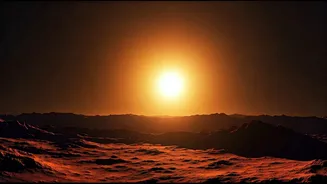
Adding to the weirdness is Venus's rotation direction. Most planets in our solar system, including Earth, spin counter-clockwise on their axis. This is known as prograde rotation. Venus, however, spins clockwise, a phenomenon called retrograde rotation. If you could stand on Venus's surface and survive the crushing pressure and searing heat, you would see the sun rise in the west and set in the east. This backward, leisurely spin is a fundamental clue to understanding why its day is so incredibly long. Scientists believe that this wasn't always the case. Something dramatic must have happened in Venus’s deep past to flip its spin and put the brakes on its rotation.
Theory 1: The Heavy Atmosphere's Drag
The leading theory points to Venus's most infamous feature: its thick, soupy atmosphere. The air on Venus is about 90 times denser than Earth's and is composed almost entirely of carbon dioxide, creating an extreme greenhouse effect. This super-heavy atmosphere doesn't just sit there; it moves rapidly, with winds whipping around the planet much faster than the planet itself rotates. This creates immense friction and powerful tidal forces, not from an ocean, but from the atmosphere itself. Over billions of years, scientists believe this atmospheric tide has acted like a giant brake, constantly pulling against the planet’s solid body and slowing its spin down to its current, sluggish pace. It's a planetary-scale example of air resistance, taken to an almost unbelievable extreme.
Theory 2: A History of Cosmic Violence
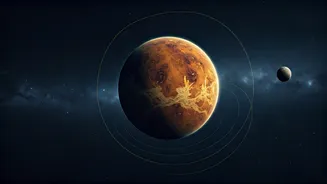
Another compelling theory suggests a more violent past. Early in the solar system's history, the space between planets was a much more chaotic shooting gallery of asteroids and planetesimals. One hypothesis is that Venus was struck by a massive object—perhaps something the size of a small planet—billions of years ago. Such a cataclysmic impact, if it hit at the right angle and speed, could have been powerful enough to not just slow Venus's original rotation but completely reverse it. A variation of this theory suggests it wasn't one giant impact, but a series of smaller, significant collisions over time that gradually nudged its spin into its current retrograde and slow state. This would explain both the direction and the length of the Venusian day.
The Sunrise-to-Sunrise Paradox
Here’s one final twist. While a single spin takes 243 Earth days (a sidereal day), the time from one sunrise to the next (a solar day) is different. Because the planet is slowly rotating backward while it also moves forward in its orbit around the sun, the two motions work against each other in a unique way. The result is that a solar day on Venus is 'only' about 117 Earth days long. So, you’d experience about two sunrises and sunsets for every one trip Venus makes around the sun. It's a confusing but fascinating consequence of its strange celestial dance, making Venus a place where our fundamental concepts of time and day are completely redefined.