




A Rare Glimpse of the Corona
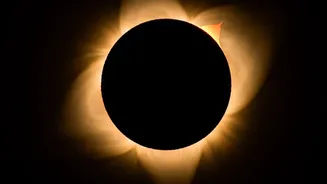
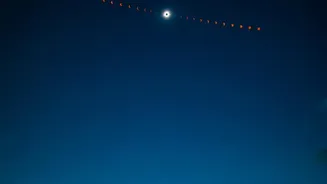
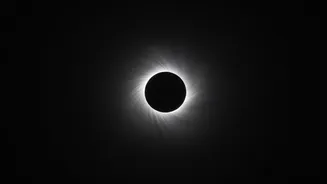
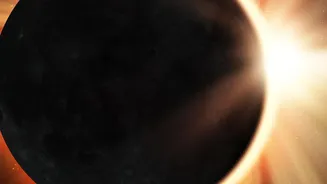
The main reason solar eclipses are scientifically vital is that they reveal the Sun’s outer atmosphere, the corona. This region is a million times fainter than the Sun's main disk, making it impossible to see under normal circumstances. During a total
eclipse, the Moon acts as a perfect natural shield, blocking the star's intense glare and allowing the pearly, ethereal corona to become visible. This allows scientists to study its structure, which is shaped by the Sun's complex magnetic fields. Understanding the corona is key to solving major solar mysteries, such as why it is hundreds of times hotter than the Sun's surface below it.
Better Than Artificial Eclipses
While scientists have instruments called coronagraphs that create artificial eclipses, they aren't a perfect substitute. These devices, both on the ground and in space, use a solid disk to block the Sun's light. However, light inevitably bends around the edge of this artificial blocker—a phenomenon called diffraction—which obscures the view of the innermost part of the corona. A total solar eclipse, with the Moon positioned far from our telescopes, provides a much clearer view of this critical lower coronal region, where many important processes that drive space weather originate.
Proving Einstein Right
One of the most famous uses of a solar eclipse in history occurred in 1919. Astronomers Arthur Eddington and Frank Dyson led expeditions to Brazil and the island of Príncipe to test Albert Einstein's then-new theory of general relativity. The theory predicted that a massive object like the Sun would bend the fabric of space-time, causing light from distant stars to curve as it passed by. This effect would be observable as a slight shift in the stars' apparent positions. An eclipse was the only time these stars, located near the Sun's disk, would be visible from Earth. The expeditions' photographs confirmed the shift, providing the first experimental proof of general relativity and catapulting Einstein to global fame.
Understanding Our Own Atmosphere
Eclipses don't just help us study the Sun; they also provide a unique way to study Earth. The sudden, localized blocking of sunlight creates a controlled experiment in our atmosphere. As the Moon's shadow passes, it causes rapid changes in temperature, wind, and the ionosphere—the electrically charged upper layer of the atmosphere. The ionosphere is crucial for communications and navigation systems, as it affects the travel of radio signals. By studying how the ionosphere responds to the eclipse's temporary blackout, scientists can better understand how it's affected by daily solar radiation and improve models for space weather.
A Continuous Hunt for Discoveries
From the discovery of the element helium in 1868 to modern studies of solar wind, eclipses have consistently driven scientific breakthroughs. During the total solar eclipse on August 12, 2026, for instance, scientists are preparing to fly research aircraft to chase the Moon's shadow, capturing high-resolution imagery of the corona. Research teams in India and elsewhere are also using eclipses to test and refine computational models that predict the corona's structure, which is crucial for forecasting solar storms that can impact satellites and power grids on Earth. Each eclipse offers a chance to see something new because the Sun is a dynamic, ever-changing star.