




A Day Longer Than A Year
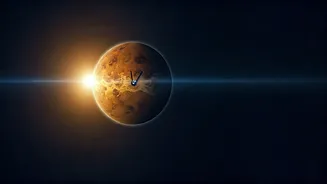
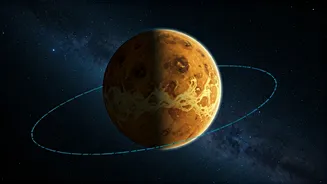
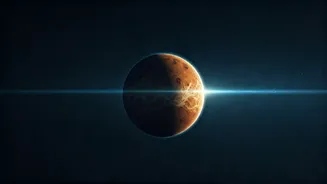
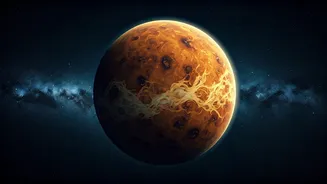
Let’s start with the truly mind-bending numbers. Venus takes about 225 Earth days to complete one orbit around the Sun. This is its year. However, it takes a staggering 243 Earth days to complete just one rotation on its axis—that’s a single Venusian
day. This means that if you could somehow stand on its scorching surface, you'd experience a year pass by before a full day-night cycle is complete. To make things even stranger, Venus spins 'backwards'. While Earth and most other planets in our solar system spin counter-clockwise, Venus has a retrograde rotation, spinning clockwise. If the Sun were visible through its thick clouds, it would rise in the west and set in the east.
The Atmosphere's Crushing Grip
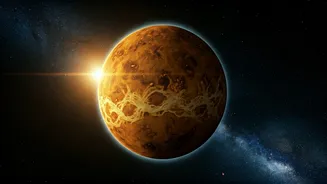
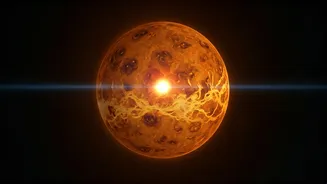
One of the primary culprits behind this planetary slowdown is Venus's atmosphere. It’s an absolute beast. Composed mainly of carbon dioxide, it’s 90 times denser than Earth’s atmosphere, creating a surface pressure equivalent to being 900 metres underwater. This thick blanket of gas doesn't just sit there; it's a dynamic, super-rotating system that whips around the planet in just four Earth days. This creates powerful 'atmospheric tides'—not of water, but of gas. The intense solar heating on the day side causes the atmosphere to bulge, and the planet’s solid body has to rotate through this thick, lagging bulge. Think of it like trying to run through a swimming pool; the drag is immense. Over billions of years, this atmospheric friction has acted as a powerful brake, slowing Venus's rotation to its current crawl.
A Tug-of-War with the Sun
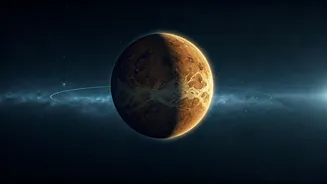
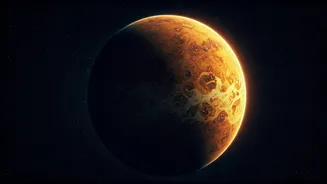
While the atmosphere puts the brakes on, the Sun is playing a different game. Just as the Moon creates ocean tides on Earth, the Sun’s immense gravity pulls on Venus, creating a 'solid body' tide—a slight stretching of the planet itself. This gravitational tug tries to get Venus into a state called tidal locking, where one side permanently faces the Sun (similar to how the same side of the Moon always faces Earth). However, the atmospheric tides and the gravitational tides are locked in a celestial tug-of-war. The atmospheric brake is stronger, but the Sun’s gravitational pull also influences the final spin rate. The delicate balance between these two opposing forces is believed to be what settled Venus into its unique, ultra-slow rotation.
Echoes From The Planet's Core
To understand a planet’s spin, you have to look deep inside it. Recent studies using powerful radar beams bounced off Venus’s surface have allowed scientists to measure its rotation and wobble with incredible precision. These measurements revealed tiny variations in the length of a Venusian day and the exact tilt of its axis. Why does this matter? Because these subtle changes give us clues about the planet’s interior. The data suggests Venus has a massive, metallic core about 7,000 kilometres in diameter, similar in size to Earth's. The nature of this core—whether it's fully liquid, solid, or a mix—is still a mystery. However, the way the planet wobbles suggests a liquid outer core that sloshes around, creating friction with the rocky mantle above it. This internal friction could be another contributing factor to dissipating rotational energy over cosmic timescales, further slowing the planet down.
A Violent Past, A Sluggish Present
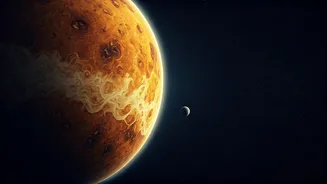
Another compelling theory suggests Venus wasn't always this slow. In the chaotic early days of the solar system, planetary formation was a violent contact sport. It’s possible that billions of years ago, a massive planet-sized object slammed into Venus. Such a cataclysmic impact could have not only stripped away any potential moons but also dramatically altered its spin, potentially even flipping it upside down and sending it into its current retrograde motion. While the atmospheric braking and tidal forces are likely responsible for fine-tuning its current speed, a giant impact may have been the event that set the stage. This idea paints a picture of Venus as a world whose strange present is a direct consequence of a traumatic past.