




The Universe's Biggest Mystery
First, a quick recap of the problem. When astronomers look at galaxies, they see them spinning so fast that, according to our understanding of gravity, they should fly apart. The visible stars and gas just don't have enough gravitational pull to hold
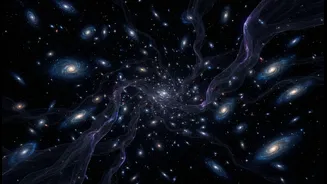
everything together. To solve this, physicists proposed an invisible 'cosmic glue' called dark matter. This mysterious substance doesn't emit or reflect light, but it has mass, and there's a lot of it. We can see its gravitational effects everywhere, from the rotation of a single galaxy to the vast web-like structure of the entire cosmos. The trouble is, every experiment designed to directly detect a dark matter particle has come up empty-handed, leading physicists to explore some truly radical ideas.
Thinking Outside Our Dimensions
One of the most creative, and frankly, weirdest ideas is that dark matter isn't in our universe at all—at least, not in the way we think. Some theories propose the existence of extra dimensions beyond the three spatial dimensions we experience (length, width, height) plus time. This isn't just science fiction; it's a concept rooted in attempts to unify the fundamental forces of nature. The idea, first floated in the early 20th century and later incorporated into things like string theory, is that these extra dimensions could be curled up incredibly tightly, too small for us to ever perceive. Or, in a stranger twist, our entire universe could be a 4D 'brane' (like a membrane) floating in a higher-dimensional space.
A Particle Hiding Next Door?
This is where dark matter comes back in. A specific version of this idea, known as a 'warped extra dimension' (WED) theory, suggests that while the particles that make up you, me, and the stars are stuck on our brane, other particles might be able to travel into the fifth dimension. According to this model, what we perceive as the gravitational effects of dark matter could be the influence of particles existing in this hidden dimension. A recent theory from the University of Sheffield proposes that the geometry of this fifth dimension could naturally cause dark matter particles to 'resonate', making them interact strongly in the early universe but appear almost inert and undetectable today. It's an elegant way to explain why dark matter has been so elusive.
The Sobering Challenge of Proof
So, is this theory correct? The honest answer is: we have no idea, and we may not know for a very long time. How do you test for a dimension you cannot see or interact with directly? Some scientists believe that extremely precise measurements from gravitational wave detectors might one day pick up faint signals from extra dimensions. Others hope that new, powerful telescopes might spot anomalies in the distribution of dark matter that point to more complex physics. But for now, the theory remains a beautiful piece of mathematics without a shred of hard evidence. It exists in the realm of 'what if' — a space that is both exciting and frustrating for physicists.
The Real Reason It Matters
This brings us to the promise of the headline. Why should we pay attention to a theory that may be untestable and could very well be wrong? Because its value isn't necessarily in being the final answer. Instead, theories like this provide a clearer view of how theoretical physics actually works. Science isn't just about confirming what we already know; it's about mapping the boundaries of our ignorance. These 'out there' ideas are a form of stress-testing our most fundamental assumptions about reality. When a theory like the Standard Model of particle physics can't explain a huge phenomenon like dark matter, it signals that new physics is needed. Wild, speculative theories, even when they fail, push our mathematical tools to their limits and can reveal unexpected connections between different problems, like the nature of gravity and the mass of the Higgs boson. They force us to ask better questions and to design more creative experiments. They are the engine of discovery, not because they are right, but because they have the courage to be profoundly wrong.