





India faces a dual challenge: feeding its people and powering its growth. What if the answer wasn't choosing between farms and solar farms, but combining them? A new wave of innovation is making it possible to harvest both food and energy from the same
land.
The Dual-Use Dilemma
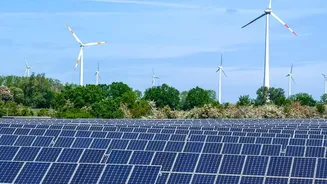
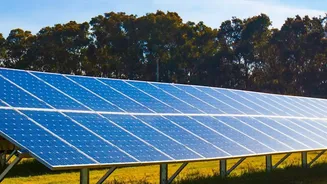
As India pushes towards ambitious renewable energy goals, vast tracts of land are required for solar farms. Often, the ideal land for solar panels—flat, open, and drenched in sun—is also prime agricultural land. This creates a direct conflict: land for food versus land for energy. Agrivoltaics, the practice of co-locating agriculture and solar power generation, offers a powerful solution to this dilemma. By mounting solar panels high above the ground or between crop rows, farmers can potentially harvest the sun twice. The concept is straightforward, but the execution presents a fundamental challenge: solar panels and crops compete for sunlight. Finding the right balance is key.
More Than Just Shade
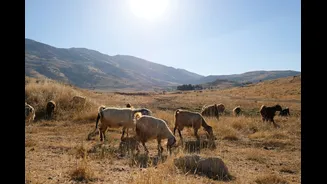
It might seem that any shade would hinder crop growth, but for many plants, the opposite is true. On hot, sunny afternoons, many plants can experience heat stress, causing them to stop growing and consume more water to stay cool. The partial shade from solar panels can protect crops from this excessive heat and light. This protective shield can lead to significant water savings by reducing evaporation from the soil and transpiration from the plants. For livestock, the panels offer welcome relief from the heat. In a symbiotic relationship, the transpiration from plants can also cool the solar panels, slightly boosting their efficiency and energy output.
Innovations in Light Management
The core of modern agrivoltaics lies in managing this delicate balance of light. Instead of simply blocking the sun, new technologies are designed to 'share' it. One major innovation is the development of semi-transparent solar panels. These panels use wavelength-selective materials that absorb the parts of the light spectrum needed for electricity while allowing the crucial photosynthetically active radiation (PAR) to pass through to the crops below. Some advanced panels even use nano-coatings or special tints, like magenta, to convert UV light into red light, which is more beneficial for plant growth. Other systems employ dynamic tracking, where panels can tilt or rotate throughout the day. This intelligent control allows them to follow the sun to maximise energy generation during certain hours and then shift to provide optimal shade for crops during the hottest parts of the day, creating a moving checkerboard pattern of light and shadow.
Smarter Panels for Smarter Farming
Beyond just sharing light, panel design itself is evolving. Bifacial panels, which can generate power from both sides, are particularly effective in agrivoltaic setups. They can be mounted vertically between crop rows, capturing direct sun on one side and reflected light from the ground and plants on the other, increasing energy output by 10-30%. This vertical orientation also leaves more space for farm machinery. Another approach involves customizing the density and spacing of solar cells within a panel. For a lettuce crop, which has a lower light requirement, panels might have a higher density of cells. For sun-loving tomatoes, the cells would be spaced further apart to allow more light to penetrate. This allows for crop-specific energy solutions.
Agrivoltaics in the Indian Context
For India, the potential of agrivoltaics is immense, though its adoption is still in the early stages. The technology promises to boost farmer incomes by providing a reliable 'third crop' in the form of electricity sales, enhancing financial stability. Projects in India have already shown that these systems can reduce water evaporation in arid regions, a critical benefit for a water-stressed nation. Furthermore, decentralized power generation on farms can reduce transmission losses and strengthen rural energy security. However, challenges remain. Agrivoltaic systems can cost 15-30% more than conventional solar farms due to the need for elevated structures. A clear policy framework and better access to finance for small farmers are needed to help scale this promising technology across the country.