





Elon Musk has a knack for making science fiction feel like a business plan. His latest headline-grabbing idea involves building artificial intelligence infrastructure in orbit, a proposal that sounds impossibly futuristic. But what is it, really?
What Musk Actually Said
In a
series of posts and comments in early November 2026, Elon Musk suggested that space is becoming an increasingly appealing environment for housing the massive data centres required for advanced artificial intelligence. He argued that as terrestrial AI data centres face growing constraints from power grids, land use, and cooling water, space offers a solution. Musk predicted that by the end of 2028 or 2029, the amount of new AI computing power, or 'compute', deployed in orbit could surpass that on Earth. He believes that eventually, an overwhelming majority of AI superintelligence compute will be based in space, a figure he suggested would round up to 100 percent.
The Vision: AI Data Centres in Orbit
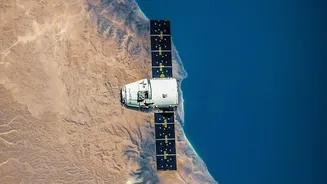
The core idea is to move the power-hungry and heat-generating work of AI data centres from the ground into a constellation of satellites. These orbital data centres would be equipped with specialised computer chips to run AI models. Instead of being limited by terrestrial power grids, they would be powered by near-continuous sunlight. And instead of needing vast amounts of water for cooling, they could radiate their heat into the cold vacuum of space. This concept, which SpaceX has internally codenamed 'Starmind', envisions a future where AI processing happens above our heads, not in sprawling warehouses on the ground.
Why Starlink is the Key
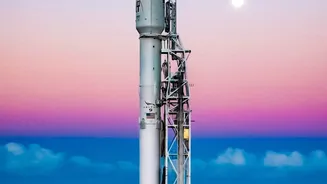
This ambitious plan doesn't exist in a vacuum. It's intrinsically linked to SpaceX's already operational Starlink satellite internet network. Starlink provides a global, high-speed, low-latency internet service through a massive constellation of satellites. This network could serve as the communications backbone for space-based AI. The orbital data centres would process information and then use Starlink's established high-speed laser links to beam the results back down to Earth. This creates a vertically integrated system: SpaceX builds the rockets (Starship) to launch the satellites, the satellites (Starlink) to provide connectivity, and now, the orbital platforms to house the AI itself. In October 2026, SpaceX had already announced upgrades to the Starlink network to better support AI and edge computing.
Potential Applications and Benefits
If successful, a space-based AI network could have profound implications. It could provide powerful AI capabilities to remote and underserved regions on Earth that lack the fibre optic infrastructure to connect to ground-based data centres. Applications could range from more accurate climate modelling and real-time disaster response to powering autonomous vehicle networks and enhancing scientific research. For space exploration, onboard AI is already critical for autonomous navigation and data analysis on missions to Mars and beyond, where communication delays make real_time ground control impossible. This new infrastructure would dramatically scale up those capabilities.
The Immense Challenges Ahead
Despite the grand vision, the technical and economic hurdles are formidable. Operating complex electronics in the harsh environment of space, with its radiation and extreme temperatures, is a major engineering challenge. While space offers a cold vacuum, efficiently radiating the intense heat generated by thousands of AI accelerators is not a simple problem to solve. Furthermore, the cost is staggering. One estimate suggests a single gigawatt orbital data centre could cost over three times more than its terrestrial equivalent. Launching and maintaining a constellation of potentially thousands or even a million such satellites represents a monumental investment and logistical undertaking, even for a company with SpaceX's launch capabilities.