




The Fiery Problem of Arrival
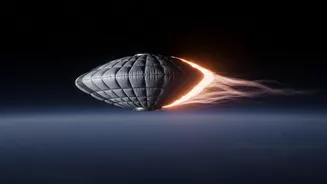
Landing a probe on a planet with an atmosphere, like Mars or Venus, presents a massive challenge. A spacecraft can enter an atmosphere at speeds exceeding 18,000 miles per hour. The friction and compression of atmospheric gases at these speeds generate
incredible heat—enough to vaporize the craft entirely. For decades, engineers have relied on rigid, often heavy, heat shields made of materials that burn away (ablative shields) or ceramic tiles that insulate the spacecraft. However, these rigid shields have a fundamental limitation: they can't be bigger than the diameter of the rocket that carries them into space. This size constraint limits the weight of the payload they can protect and the altitudes at which they can effectively land, which is a major hurdle for ambitious future missions.
A Bigger Brake You Can Pack
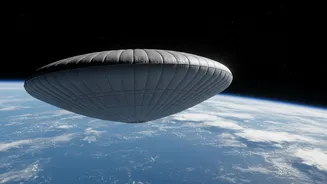
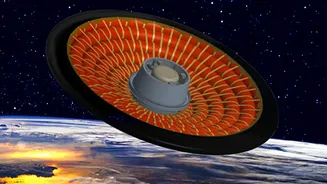
The solution sounds like something from science fiction: a heat shield that you can pack down, launch, and then inflate just before you need it. This is the core idea behind the Hypersonic Inflatable Aerodynamic Decelerator (HIAD). Instead of being limited by the rocket's fairing, an inflatable shield can be deployed to a much larger diameter. This larger surface area acts like a giant brake, creating significantly more drag. This allows the spacecraft to start slowing down much higher in a planet’s thin upper atmosphere, leading to a gentler descent with less intense heating. The technology has been in development for over a decade, culminating in successful tests like NASA's Low-Earth Orbit Flight Test of an Inflatable Decelerator (LOFTID).
Anatomy of an Inflatable Shield
So, how does a 'balloon' survive temperatures that can reach nearly 3,000 degrees Fahrenheit? It's a multi-layered marvel of material science. The inflatable structure itself is made of a series of connected rings, or tori, woven from synthetic polymers that are, by weight, many times stronger than steel. These rings are inflated with nitrogen gas to form a rigid, mushroom-shaped shield. But the inflatable part never touches the intense heat directly. It's protected by a flexible thermal protection system. The outermost layer is a woven ceramic fabric, often made of silicon carbide, which can withstand extreme temperatures. Beneath this are layers of advanced insulation that keep the heat from reaching the inflatable structure, ensuring it maintains its shape and integrity throughout the fiery descent.
LOFTID's Successful Plunge
The technology took a major leap forward with the LOFTID mission in November 2022. Launched as a secondary payload, the 6-meter (about 20-foot) diameter shield was inflated in space and then sent plummeting back to Earth. It successfully endured the punishing forces and heat of re-entry from orbital speeds, splashing down safely in the Pacific Ocean where it was recovered. The test was declared a huge success by NASA, proving that the inflatable structure could survive the dynamic pressure and that the thermal protection system worked as designed. The data gathered from LOFTID's array of sensors is now crucial for designing future, even larger shields for specific missions.
Unlocking the Solar System
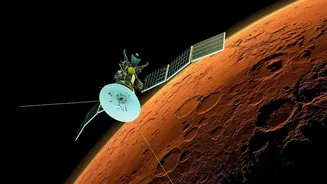
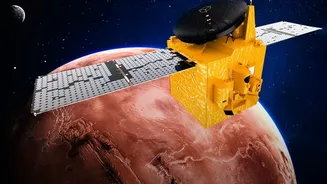
The success of inflatable heat shields isn't just an engineering milestone; it's a key that unlocks the next generation of space exploration. With this technology, NASA can plan for landing heavier payloads on Mars, including the equipment needed for future human missions. It also opens up possibilities for exploring worlds with thick atmospheres like Venus and Saturn's moon Titan. Beyond planetary science, the technology has commercial applications. Companies are looking at using smaller versions to safely return experiments or in-space manufactured goods from low-Earth orbit. United Launch Alliance has even considered using the technology to recover valuable rocket engines for reuse, a major step toward more cost-effective access to space.