
More Than Just a Souvenir
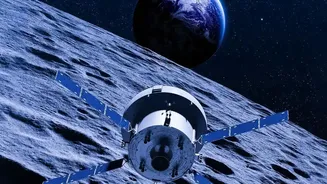
Scheduled for launch around 2028, Chandrayaan-4 is India's first lunar sample-return mission. While humanity has brought back Moon rocks before, this mission is different. Its target is the lunar south pole, a region believed to hold a resource far more
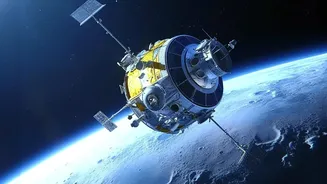
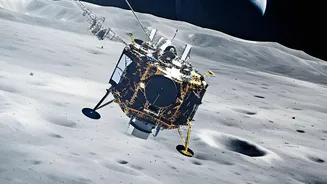
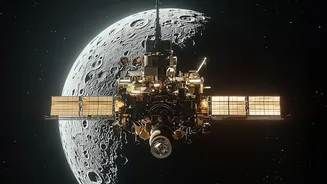
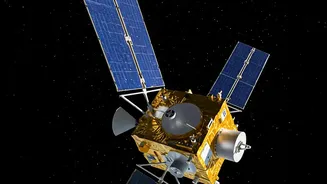
valuable than rock: water ice. The mission is extraordinarily complex, involving five separate spacecraft modules and two separate rocket launches using the powerful LVM3. The plan involves landing a robotic craft, drilling and scooping up surface and sub-surface samples, launching those samples back into lunar orbit, docking with an orbiting transfer module, and finally, returning the precious cargo safely to Earth. Success would make India only the fourth country in history to accomplish a lunar sample return, placing it in an elite club alongside the US, the former Soviet Union, and China.
The Treasure in the Shadows
The entire premise of a sustainable human presence on the Moon hinges on a concept called In-Situ Resource Utilisation (ISRU) — essentially, living off the land. Transporting materials from Earth is incredibly expensive, so using what's already on the Moon is crucial. The most vital of these resources is water ice, which is believed to exist in large quantities in the permanently shadowed regions near the lunar poles. These are craters where the floor has not seen direct sunlight for potentially billions of years, creating 'cold traps' where ice can remain stable just below the surface. Following Chandrayaan-3's confirmation of sulphur and other elements, Chandrayaan-4 aims to be the first mission to bring back physical samples of this ice-rich soil for direct analysis. This will provide definitive answers about its composition, purity, and accessibility.
A Lunar Gas Station
So, why is this frozen water so important? Its potential uses are transformative. First, it can be filtered into drinking water for astronauts and used for growing plants, essential for any long-term habitat. But its true game-changing potential comes from electrolysis, the process of splitting water (H2O) into its component parts: hydrogen and oxygen. The oxygen can be used to create breathable air for a Moon base. Even more critically, liquid hydrogen and liquid oxygen are the primary components of modern rocket propellant. By harvesting lunar ice, the Moon could be transformed from a barren destination into a cosmic refueling station. This would dramatically lower the cost and complexity of missions to Mars and beyond, as spacecraft could launch from Earth with less fuel and top up their tanks at the Moon for the next leg of their journey.
The Immense Technical Challenge
Fetching lunar ice is a monumental engineering feat. The mission requires mastering technologies that ISRO has never attempted before on this scale. The spacecraft must perform a precision landing near a polar region, where the terrain is treacherous and lighting conditions are difficult. Then, a robotic arm and drill must operate in cryogenic temperatures to excavate the ice-mixed regolith. The most complex part involves the ascent: a small rocket must lift off from the Moon's surface, rendezvous and dock with the transfer module waiting in lunar orbit — a process that must be executed flawlessly and autonomously. The entire architecture, involving two launches and multiple modules, highlights the mission's complexity, which is comparable to China's recent Chang'e sample-return missions. The success of Chandrayaan-4 will validate these key technologies, which are foundational for India's long-term goal of a crewed lunar landing by 2040.
Pioneering a New Lunar Economy
Chandrayaan-4 is not operating in a vacuum. It is a critical component of a global push toward the Moon, and it positions India as a key player. The mission's findings will be invaluable to international partners and are closely related to the objectives of the LUPEX (Lunar Polar Exploration) mission, a joint project between ISRO and Japan's space agency, JAXA. While Chandrayaan-4 is an independent Indian mission, it has superseded LUPEX in ISRO's immediate timeline, highlighting its strategic priority. By successfully retrieving and analyzing the first samples from the lunar polar regions, India will gain a crucial seat at the table in discussions about space resources and the future governance of celestial bodies. It moves India from being a participant in lunar exploration to a leader in enabling a sustainable off-world economy.