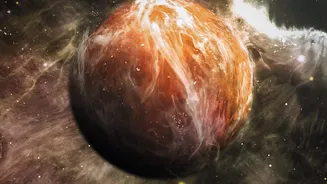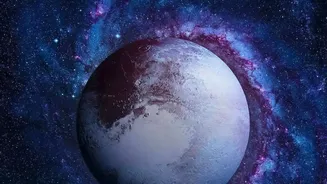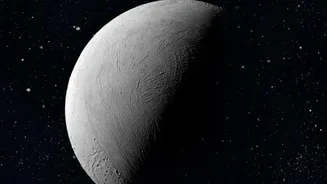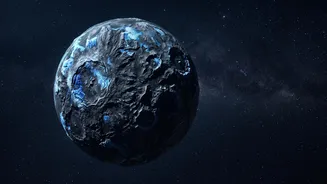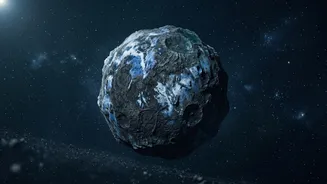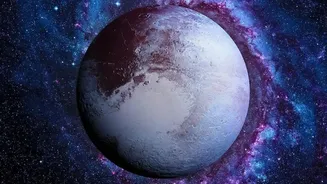



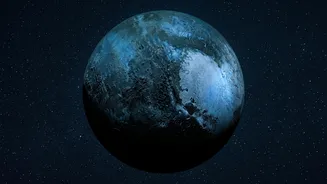

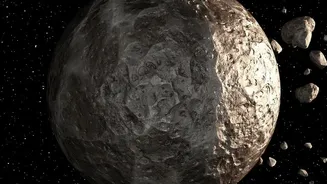
Beyond the orbit of Neptune lies a vast, frozen frontier teeming with mysterious objects. Recently, bodies like 2026 ED138 have drawn scientific attention, raising a big question: could it be the solar system's next dwarf planet?
The Official Dwarf Planet Checklist
So, what does it take
to join the ranks of Pluto, Ceres, and Eris? In 2006, the International Astronomical Union (IAU) laid out a three-point checklist. First, the object must orbit the Sun, not another planet. Second, it must have enough mass and gravity to pull itself into a nearly round shape, a state called hydrostatic equilibrium. This is the key physical trait that separates them from lumpy, irregular asteroids. The third rule is what truly sets dwarf planets apart from full-fledged planets: they have not 'cleared their orbital neighborhood'. This means their gravity isn't strong enough to dominate their orbit and sweep it clean of other large objects. Pluto, for example, shares its orbital space with other bodies in the Kuiper Belt, which is why it was reclassified.
Size, Shape, and the Tipping Point
For a distant object like 2026 ED138, the most crucial question is whether it has achieved that round shape. Scientists can't just fly out and look, so they rely on clever detective work. The object's brightness, combined with estimates of its distance and surface reflectivity, helps them calculate its size. An object like 2026 ED138, estimated to be between 600 and 1,500 kilometres across, is a very strong candidate. Scientists believe that for icy bodies, which make up most of the Kuiper Belt, the minimum size to become round is somewhere between 300 and 400 kilometres in diameter. Rocky bodies need to be larger. Because candidates like 2026 ED138 appear to be well above this threshold, astronomers strongly suspect its own gravity has been powerful enough to shape it into a sphere over billions of years.
A Neighborhood Full of Neighbors
The final criterion—not clearing its orbit—is practically a given for objects discovered in the Kuiper Belt. This region, a vast debris field of icy and rocky bodies beyond Neptune, is incredibly crowded. Unlike Earth or Jupiter, which are the undisputed gravitational kings of their orbital paths, a Kuiper Belt Object (KBO) is just one resident among thousands. The discovery of Eris in 2005, an object more massive than Pluto, forced astronomers to confront this reality. Either they had to add potentially hundreds of new planets to the roster, or they needed a new classification. They chose the latter, creating the 'dwarf planet' category. Therefore, the very location of an object like 2026 ED138 in this busy cosmic neighborhood means it automatically fails the 'clearing its orbit' test, making it a perfect candidate for dwarf planet status if it's proven to be round.
How Scientists Gather the Evidence
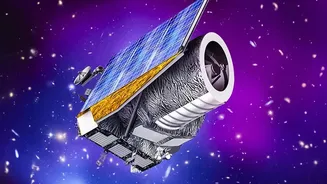
Confirming the status of a world tens of times farther from the Sun than Earth is a monumental challenge. Powerful tools like the Vera C. Rubin Observatory, which first spotted 2026 ED138, are essential. Astronomers track the object's slow path across the sky over many nights, and even search archival data from other telescopes to map its orbit over years. Subtle variations in the object's brightness can reveal how fast it's spinning and give clues about its shape—a perfectly stable brightness suggests a uniform sphere viewed from its pole. The holy grail of confirmation often comes from discovering a small moon orbiting the candidate. By observing the moon's orbit, scientists can precisely calculate the primary object's mass, which is the final piece of the puzzle needed to confirm it has achieved hydrostatic equilibrium.
Why the 'Potential' Status Matters
The 'candidate' or 'potential' label isn't just scientific indecision; it's a vital part of the discovery process. The IAU is cautious and requires a high burden of proof before officially bestowing the dwarf planet title. Currently, only five objects are officially recognized: Ceres, Pluto, Haumea, Makemake, and Eris. However, there are dozens, perhaps hundreds, of other known objects in the outer solar system that are considered likely candidates, including large bodies like Gonggong, Quaoar, and Sedna. The study of 2026 ED138 and its peers is more than just a quest for classification. Each new discovery is a frozen time capsule from the solar system's formation, offering invaluable clues about how planets form and evolve.