




Look for the Lord of the Rings: Saturn
While Jupiter commands the pre-dawn sky, Saturn is the main planetary attraction in the evenings. Each night in late August, the ringed planet rises a little earlier, making it easier to spot. Look for a steady, yellowish point of light ascending in the eastern
sky as evening progresses. Though it won't reach its peak brightness until its opposition in October, Saturn is already a magnificent target. Even a basic pair of binoculars will hold it steady, revealing it as a distinct disc rather than a twinkling star. In a small telescope, its famous rings become visible, a sight that never fails to inspire awe. Throughout August, it rises in the evening and remains visible for most of the night, a constant and rewarding presence for patient observers.
Spot the Summer’s Giant Signpost
High overhead on any clear August evening, you'll find one of the sky's most recognisable patterns: the Summer Triangle. This is not an official constellation but an asterism, a simple shape formed by three of the brightest stars in the sky. Its three corners are Vega, Deneb, and Altair, each the brightest star in its own constellation (Lyra the Lyre, Cygnus the Swan, and Aquila the Eagle, respectively). Vega is the brightest of the trio and appears almost directly overhead in the late evening. From there, you can trace a line to the bright star Altair to the south, and another to Deneb, which forms the tail of the swan. The band of the Milky Way runs right through the triangle, making it a rich area to scan with binoculars from a dark-sky location.
Hunt for a Different Kind of Shooting Star
The Perseids get all the glory, but they aren't the only meteor shower active in August. The Kappa Cygnids continue to streak across the sky until around August 25. Now, it's important to set expectations: this is a very minor shower, producing only about three meteors per hour at its best. What it lacks in numbers, however, it makes up for in character. Kappa Cygnid meteors are known for being exceptionally slow and are often very bright, sometimes producing spectacular fireballs that leave a lasting impression. The hunt for them is more of a quiet, patient celestial scavenger hunt than the busy spectacle of the Perseids. Since their radiant point is in the constellation Cygnus—part of the Summer Triangle—you’ll already be looking in the right direction.
Catch Dazzling Venus in the Evening
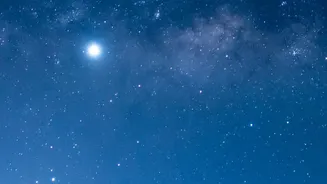
You don't need a map or any special equipment to find the brightest planet in our sky. Throughout August, Venus has been a brilliant beacon in the western sky right after sunset. Often called the "Evening Star," its intense, silvery light is unmistakable, outshining every other star and planet. Venus is so bright because its thick clouds reflect a huge amount of sunlight. As it approaches its greatest eastern elongation, it appears at its farthest from the Sun in our sky, making it a prominent feature of the twilight hours. Don't wait too long after sunset to look for it; as the sky darkens, Venus will sink toward the horizon. Its sheer brilliance makes it a simple yet stunning target for even the most casual skywatcher.
Mark Your Calendar for a Lunar Grand Finale
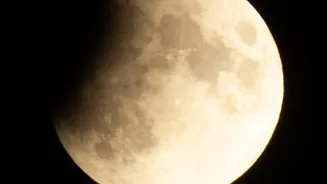
Perhaps the biggest celestial event remaining in August is a deep partial lunar eclipse, set to occur on the night of August 27-28. During this event, a significant portion of the full Moon will pass through the darkest part of Earth's shadow, known as the umbra. Unlike a total lunar eclipse where the Moon is fully engulfed, this partial eclipse will see up to 96 percent of the Moon's surface covered. As it moves through the shadow, the eclipsed portion of the Moon will likely take on a subtle reddish or coppery glow. The event will be widely visible, offering a fantastic opportunity for observation and photography across the country. It’s a perfect way to close out a month of incredible skywatching.