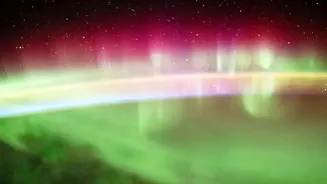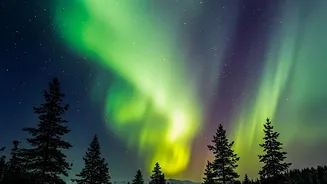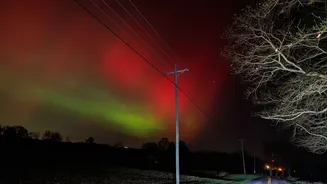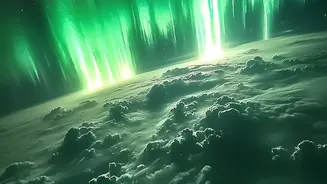


The ethereal dance of the aurora is one of nature’s most breathtaking spectacles. But behind the beautiful curtains of light lies a powerful and complex process, one that new research shows is intimately connected to potentially damaging electrical currents
on Earth.
More Than a Light Show
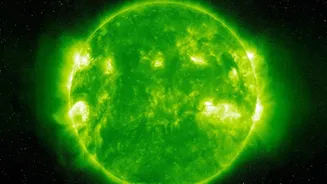
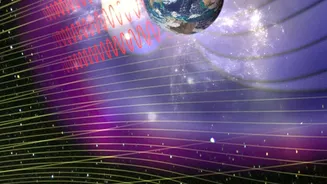
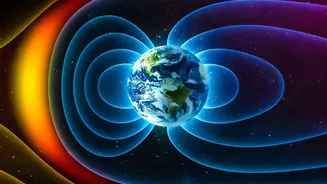
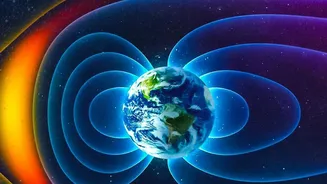
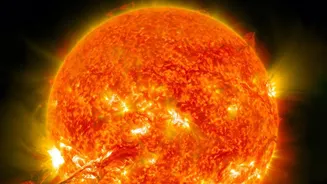
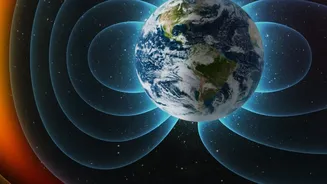
For centuries, the aurora borealis and australis have captivated observers, inspiring myth and wonder. Scientifically, we know these lights are created when charged particles from the sun, carried by the solar wind, interact with Earth's magnetic field. These particles are channelled towards the poles, where they collide with atoms like oxygen and nitrogen in the upper atmosphere, causing them to glow. However, the process is far from gentle. The same forces that paint the sky with vibrant colours are part of a larger phenomenon called space weather, which can have significant consequences for our technology-dependent world. At the heart of the most dynamic auroral displays are events known as auroral substorms — intense, temporary bursts of energy in Earth’s magnetic environment, or magnetosphere.
The Cosmic Chain Reaction
An auroral substorm is an explosive release of energy that has been stored in Earth's magnetotail, the part of the magnetic field stretched out away from the Sun. This process, often triggered by a magnetic phenomenon called 'reconnection', acts like a cosmic slingshot, flinging energetic particles back towards our planet at high speeds. These particles not only create a sudden brightening and rapid movement of the aurora but also drive powerful electrical currents in the ionosphere, an upper layer of our atmosphere. It is the rapid fluctuation of these massive currents, flowing roughly 90 to 150 kilometres overhead, that creates a disturbance that doesn't just stay in the sky. New research has focused on understanding just how quickly this disturbance travels from deep space to the ground beneath our feet.
From Space to Ground in Minutes
Recent studies have confirmed a remarkably fast connection. When that energy is released in the magnetotail, tens of thousands of kilometres away, the effects can be felt on the ground in a matter of minutes. As the electrical currents in the ionosphere surge and change, they induce a corresponding fluctuation in Earth’s magnetic field at the surface. Following a fundamental principle of physics known as Faraday's law of induction, these changing magnetic fields create their own electrical currents on the ground. These are called geomagnetically induced currents, or GICs. They flow through any conductive material, including the soil, rock, and, most critically, our man-made infrastructure.
The Threat to Power Grids
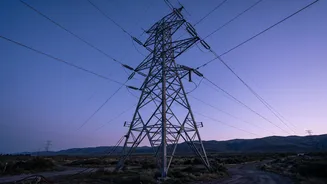
Power grids, with their thousands of kilometres of high-voltage transmission lines, are exceptionally long conductors, making them highly susceptible to GICs. These currents are quasi-DC (direct current) in nature, which is a problem for transformers designed to operate on AC (alternating current). When GICs enter a transformer, they can saturate its magnetic core, causing it to overheat, vibrate, and, in severe cases, sustain permanent damage. This can lead to protective relays tripping, voltage instability across the grid, and potentially widespread blackouts. The 1989 collapse of the HydrostQuébec power system, which left millions in Canada without power for nine hours, is a classic example of the damage GICs can inflict. More recently, a geomagnetic storm in May 2024 caused disruptions to the power grid in Sweden.
What New Research Reveals
The latest research reinforces that the aurora is a visual warning sign of these invisible ground currents. By combining data from spacecraft with ground_based magnetometers,, scientists can now trace the entire sequence from the initial energy release in space to the resulting magnetic fluctuations on the ground. A key finding is that the strength of the GICs is not uniform;; it can vary significantly from one location to another just tens of kilometres apart. This localised intensity depends on factors like the conductivity of the local geology and the upper atmosphere. This means that even if a spectacular aurora is visible overhead,, most intense ground currents might be occurring elsewhere,, making prediction and mitigation a complex challenge.