





The Ephemeral Beauty of Rings
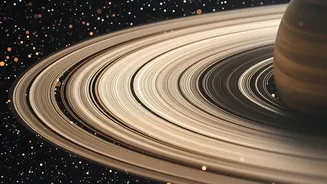
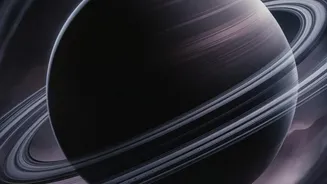
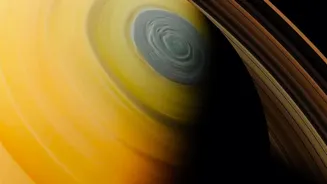
Planetary rings are one of the most iconic sights in our solar system. While Saturn possesses the most famous and extensive system, Jupiter, Uranus, and Neptune also have rings of their own. These are not solid, static hoops but are composed of countless
individual particles of ice and rock, ranging in size from tiny dust specks to house-sized boulders, each orbiting its parent planet. However, these brilliant structures face a number of threats. They are constantly losing material, with particles raining down into the planet's atmosphere or being ejected from the system. This constant erosion means that, left to their own devices, the rings should darken and disappear over cosmically short timescales. This created a puzzle for astronomers: if the rings are constantly falling apart, why are they still here, and why do they look so bright and 'young'?
A Constant Cosmic Sandblasting
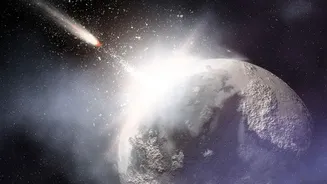
The answer lies in a relentless, system-wide process: bombardment by micrometeoroids. The solar system is far from empty; it is filled with a diffuse cloud of tiny dust particles, most smaller than a grain of sand. These particles are the debris from colliding asteroids and the dusty tails of comets. Travelling at incredible speeds, this interplanetary dust constantly collides with every object in the solar system, from planets and moons to the individual particles that make up their rings. This process is akin to a perpetual, high-velocity sandblasting. While each individual impact is tiny, their cumulative effect across the vast expanse of a ring system is enormous and plays a crucial role in its evolution.
The Physics of a High-Speed Impact
When a micrometeoroid travelling at tens of thousands of kilometres per hour strikes an icy particle in a planetary ring, the result is dramatic. The immense energy of the impact instantly vaporises the micrometeoroid and a small portion of the ring particle's surface. This creates an expanding cloud of superheated vapour. As this cloud rapidly expands and cools, it condenses into a spray of fresh, nano-scale dust and ice crystals. This newly created material is then thrown from the point of impact, creating what scientists call 'ejecta clouds'. These clouds of freshly generated dust don't just disappear; they are launched into new, slightly tilted orbits around the planet. The entire process acts like a cosmic factory, shattering existing ring material and churning out a constant supply of fine, fresh dust.
Painting the Rings Anew
This continuous generation of dust has profound effects. Firstly, it keeps the rings looking bright. Over millions of years, the pristine ice that makes up most of Saturn's rings would be expected to get 'dirty' as it accumulates darker, rocky material from micrometeoroids. However, the impact process constantly creates fresh, clean icy surfaces, which helps maintain the rings' high reflectivity. Secondly, this dust doesn't always stay put. The ejecta clouds spread out, redistributing material throughout the ring system. Some of this dust eventually falls back onto the main rings, while other particles can be captured by nearby 'shepherd' moons, which is how moons like Pan and Atlas have developed their distinct 'ravioli' shape with dusty skirts around their equators. Data from NASA's Cassini mission confirmed that the Saturn system is incredibly dynamic, with this impact process being a key engine of change.
Beyond Saturn's Majesty
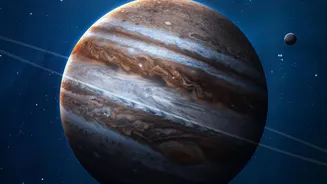
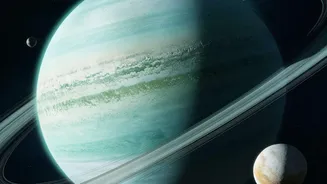
While Saturn's rings are the most massive, the same process is even more critical for the fainter rings of the other giant planets. The tenuous, dusty rings of Jupiter are believed to be constantly replenished by micrometeoroid impacts on its small inner moons, like Metis and Adrastea. These impacts kick up dust from the moons' surfaces, which then settles into orbit, forming the rings. Similarly, the dark, narrow rings of Uranus and the faint arcs of Neptune are also shaped and maintained by this interplay of moons and micrometeoroid dust. Without this continuous generation of fresh material from impacts, these less substantial ring systems would likely have vanished long ago. It shows that what looks like empty space is actually a busy, creative environment.