





The Coolest Spot in the Universe
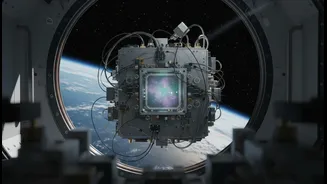
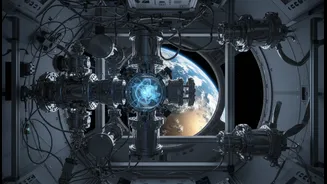
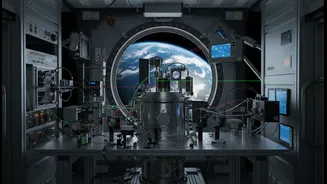
Imagine a place colder than deep space. That place is inside a mini-fridge-sized box on the International Space Station (ISS) called the Cold Atom Lab (CAL). Since its installation in 2018, this remarkable instrument has been remotely operated from Earth
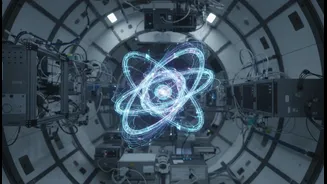
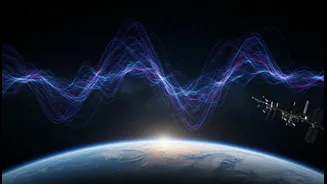
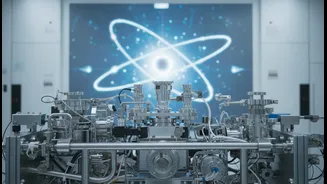
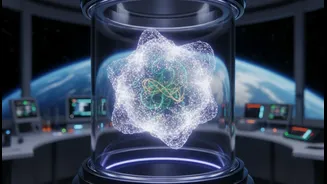
to achieve temperatures just a fraction of a degree above absolute zero, the theoretical point where all atomic motion ceases. The goal is to study a bizarre state of matter called a Bose-Einstein condensate (BEC). First predicted by Albert Einstein in 1924, a BEC forms when a cloud of atoms is cooled so dramatically that the individual atoms lose their distinct identities and begin to behave as a single, massive quantum wave. This allows scientists to observe quantum phenomena, which usually happen at the invisible, subatomic level, on a scale large enough to be studied.
Why Go to Space to Get Cold?
Creating a Bose-Einstein condensate is difficult enough on Earth, requiring complex set-ups of lasers and magnetic traps to cool and hold the atoms. The problem is gravity. On Earth, as soon as scientists release the atoms from their trap to study them, gravity pulls them down, limiting observation time to mere fractions of a second. In the microgravity environment of the ISS, however, the atoms are in a state of continuous freefall. This allows the condensates to be observed for much longer periods—sometimes over a second—giving researchers a clearer, more extended view of their quantum behaviour. This unique environment allows the atoms to be held in weaker traps, which in turn helps them reach even colder temperatures than is possible on Earth, making the CAL a one-of-a-kind physics frontier.
Early Successes and Upgrades
The Cold Atom Lab has been a story of steady progress. It successfully produced the first-ever BEC in Earth orbit shortly after it was installed in 2018. Since then, it has been a workhorse for five international research teams, studying everything from the interactions between different types of atoms to creating exotic, hollow bubble-shaped condensates that would be impossible to form on the ground. The facility has received several major upgrades, including one in April 2026 that introduced a redesigned magnetic trap and improved atom sources. These enhancements expand the lab's capabilities, allowing scientists to create larger condensates and explore new quantum phenomena with even greater precision. The lab now works with both rubidium and potassium atoms, enabling the study of dual-species quantum gases.
A Marathon, Not a Sprint
For all its success, it's crucial to understand that the Cold Atom Lab is a tool for fundamental physics. Its purpose is to build a foundation of knowledge, not necessarily to produce immediate, world-changing technologies. The insights gained are subtle and cumulative. The headline-grabbing applications—like ultra-precise navigation for deep space missions, improved atomic clocks, or new ways to monitor Earth's climate—are still on the horizon. As NASA project scientist Ethan Elliott put it, the first quantum revolution gave us lasers and cellphones; the work being done now is part of "Quantum 2.0," the direct manipulation of quantum states. The gains from this new era will likely be just as profound, but they will take time to realise. The CAL provides the context and data for that future, but it is not a guarantee of a specific outcome on a specific timeline.
The Future of Quantum Research in Orbit
The Cold Atom Lab serves as both a powerful research facility and a crucial testbed for future space-based quantum instruments. Scientists are already using it to perform atom interferometry, a technique that uses the wave-like nature of atoms to make incredibly precise measurements of forces like gravity. This could lead to future missions that can map the movement of water under Earth's surface or even probe the mysteries of dark matter and dark energy. The ongoing success of the CAL demonstrates that complex quantum technology can operate reliably in space, paving the way for more advanced instruments. As commercial operations in low-Earth orbit expand, the lessons learned from the Cold Atom Lab will be invaluable in transitioning these advanced quantum technologies from pure science to practical applications.