
A 'Chirp' from the Void
For the briefest moment, a signal billions of years old washed over the Earth. This was not light or sound in the traditional sense, but a gravitational wave—a distortion in spacetime itself. First predicted by Albert Einstein a century ago, these waves
are generated by the most violent events in the universe. Imagine spacetime as a stretched trampoline; when massive objects like black holes spiral into each other and merge, they create ripples that travel outward at the speed of light. For decades, this was only a theory. But since 2015, a global network of observatories—the Laser Interferometer Gravitational-Wave Observatory (LIGO) in the United States, Virgo in Italy, and KAGRA in Japan—has been able to detect these faint cosmic tremors. By measuring infinitesimal changes in the distance between mirrors set kilometres apart, these detectors act as our planet's ears, listening to the universe's hidden symphony. This latest detection was special, confirming an event astronomers had long hoped to witness.
The Cosmic Middle Child
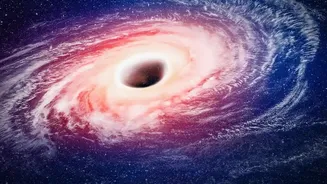
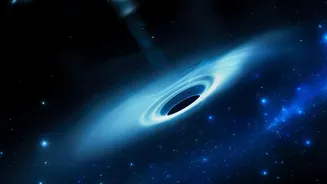
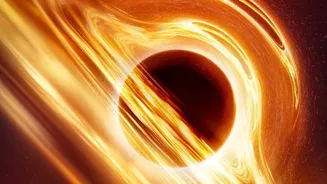
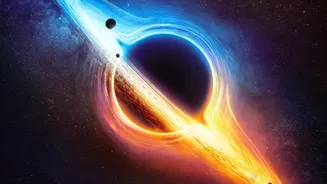
Astronomers have long known about two main types of black holes. The first are stellar-mass black holes, which are typically 5 to 50 times the mass of our sun, formed from the collapse of a single massive star. At the other extreme are the supermassive black holes, behemoths millions or even billions of times our sun's mass, which sit at the heart of nearly every large galaxy, including our own Milky Way. But between these two categories lay a frustrating gap: the intermediate-mass black holes (IMBHs), with masses ranging from 100 to 100,000 times that of the sun. Scientists were confident they must exist, but finding direct evidence proved incredibly difficult. This recent gravitational wave signal, however, came from the collision of two smaller black holes that merged to form a new one squarely in this intermediate-mass range, providing the first definitive proof of this 'missing link'.
Why This Discovery Matters
Finding an intermediate-mass black hole is more than just ticking an item off a cosmic checklist. It helps solve one of the biggest puzzles in astrophysics: how do supermassive black holes get so big, so quickly? The universe is not old enough for them to have grown simply by sucking up surrounding gas and dust. One leading theory is that they grew hierarchically. In this scenario, smaller stellar-mass black holes merge to form intermediate ones. These IMBHs then continue to merge with other black holes and stars over cosmic time, eventually forming the supermassive giants we see today. This newly observed merger is a snapshot of that process in action. It’s the first piece of direct evidence supporting the theory that galaxies grow their central black holes from these mid-sized building blocks.
The Dawn of a New Astronomy
Each gravitational wave detection opens a new window onto the universe. Unlike telescopes that rely on light, which can be blocked by dust and gas, gravitational waves travel unimpeded, carrying direct information about their cataclysmic origins. The LVK (LIGO-Virgo-KAGRA) collaboration has been steadily building a catalogue of these cosmic events, with recent upgrades allowing them to detect several mergers per week. This flood of new data is allowing astronomers to map the black hole population across the universe, test the limits of Einstein's theory of general relativity, and even measure the expansion rate of the universe with greater precision. As detectors become even more sensitive, and with future space-based observatories like LISA planned, we are moving into an era where we can track these collisions from years before they happen, offering an even deeper understanding of how these enigmatic objects form and evolve.