



Cosmic Whispers in Spacetime
Imagine dropping a stone into a still pond. The ripples that spread out tell you something happened, even if you didn't see the splash. Gravitational waves are similar, but on an unimaginable scale. First predicted by Albert Einstein over a century ago,
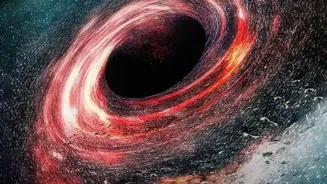
they are disturbances in the fabric of spacetime, caused by the most violent and energetic events in the cosmos, like the collision of black holes. For most of history, we were deaf to these signals. But thanks to incredibly sensitive observatories like LIGO, Virgo, and KAGRA, we can now detect these faint tremors. Each detection is a snapshot of a cataclysmic event that may have happened millions or even billions of light-years away, offering a new way to observe the universe.
The Missing Middle Child
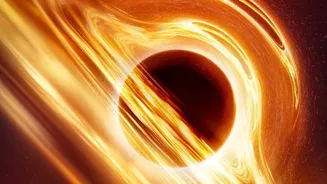
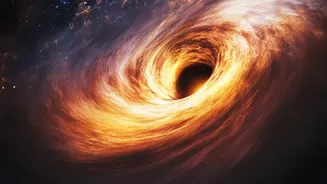
Astronomers have long known about two main types of black holes. First, there are stellar-mass black holes, with masses up to a few dozen times that of our sun, left behind when giant stars die. Then there are the supermassive black holes (SMBHs), giants weighing millions to billions of times our sun's mass, which sit at the heart of nearly every large galaxy, including our own Milky Way. But for decades, there was a huge gap in between: the so-called 'intermediate-mass black holes' (IMBHs). With masses from a hundred to thousands of suns, these IMBHs were the theoretical missing link. Scientists believed they must exist, but finding them proved incredibly difficult. Their discovery is crucial because they might hold the key to a fundamental question: how did supermassive black holes get so big?
A Ladder of Cosmic Growth
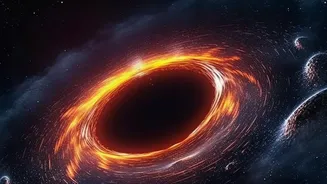
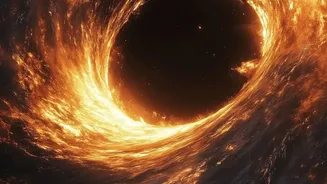
The leading theory is that supermassive black holes grew through a process called hierarchical merging. The idea is that smaller black holes merge to form larger ones, which then merge again, climbing a ladder of mass over cosmic time. This is where intermediate-mass black holes come in. They are both the product of earlier, smaller mergers and the building blocks for the next stage of growth. When two IMBHs in a dense star cluster spiral towards each other and collide, they create a single, more massive black hole and, in the process, send out a powerful burst of gravitational waves. By detecting these specific gravitational wave signals, scientists can confirm not just the existence of IMBHs, but also witness the very process that likely built the galactic anchors of our universe.
Architects of the Cosmos
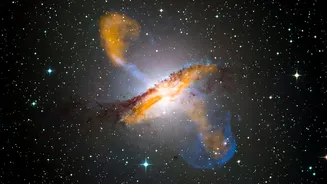
These mergers do more than just create bigger black holes; they actively shape the galaxies around them. The growth of a central supermassive black hole influences how its host galaxy forms and evolves. The immense gravity of a growing SMBH dictates the movement of stars and gas, triggers bursts of star formation, and can even clear out material, regulating the galaxy's size and structure. Evidence suggests that dwarf galaxies, which often contain IMBHs, are pulled into larger galaxies like the Milky Way. Over time, their central IMBHs can sink towards the core of the larger galaxy, eventually merging with its central supermassive black hole and contributing to its growth. By studying the frequency and nature of IMBH mergers through gravitational waves, scientists are essentially watching the blueprint of the universe being drawn.