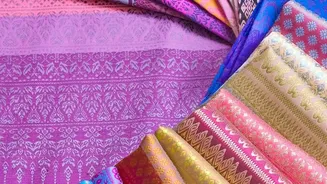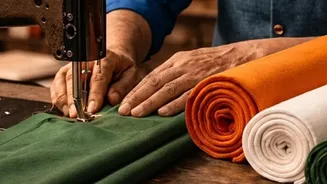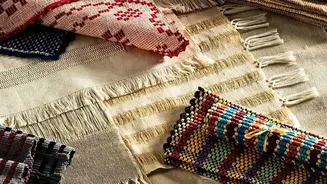




Beyond its striking beauty, the deep indigo and madder red of Ajrakh fabric tell a story stretching back millennia. This is more than just a textile; it is a living chronicle of artistry, community, and a deep connection to the natural world.
A Legacy in Indigo and Crimson
The story
of Ajrakh is as rich and layered as the fabric itself, with roots tracing back over 4,000 years to the Indus Valley Civilization. Archaeologists have discovered textile fragments from ancient sites that suggest an early mastery of dyeing with madder root. The craft as we know it today flourished in the desert regions of Sindh (now in Pakistan), Kutch in Gujarat, and Barmer in Rajasthan. It was carried and perfected by artisan communities, most notably the Khatris, who migrated and settled in Kutch around the 16th century. The name itself is believed to derive from 'azrak', the Arabic word for blue, a nod to the brilliant indigo that forms the soul of the textile. For centuries, Ajrakh was not a fashion statement but a cultural identifier, worn by the pastoral Maldhari community as turbans, shawls, and lungis that marked their identity and major life events.
The Symphony of Earth and Hand
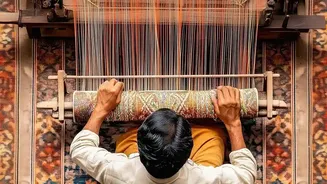
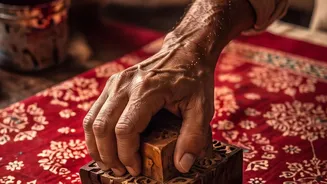
Creating a single piece of Ajrakh is a testament to patience and precision, involving a laborious process with anywhere from 14 to 22 distinct stages that can span several weeks. It begins with washing the cotton or silk fabric and treating it with natural solutions like castor oil and soda ash to soften the fibres. This is a 'resist-dyeing' technique. Artisans use hand-carved wooden blocks to meticulously stamp a resist paste—a mixture of lime and gum arabic—onto the cloth. This paste protects certain areas from the dye. The process is a true collaboration with nature. The fabric is repeatedly dipped in vats of natural dyes like indigo for blue and madder root for red. It is washed, often in running river water, and dried in the sun, which helps to fix and brighten the colours. The hallmark of true Ajrakh is that the intricate patterns are printed with remarkable precision on both sides of the fabric.
Geometry and Nature in Every Motif
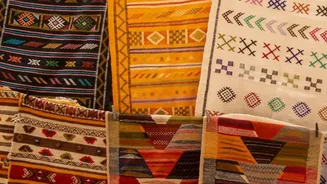
The intricate patterns of Ajrakh are not random decorations; they are a complex language of symbolic and geometric motifs. The designs are a fusion of Islamic and local traditions, often reflecting a deep connection to the cosmos. Many patterns are built on the principles of precise symmetry, representing the infinite nature of the universe. Common motifs include stars, floral rosettes, medallions, and intricate lattice-work. The deep indigo blue is said to represent the night sky, while the earthy madder red symbolises the earth or the sun. Black, created from a fermented mix of scrap iron and jaggery, provides the sharp outlines that define the patterns, while the un-dyed white offers balance. Traditionally, the artisans avoided human and animal figures, favouring a vocabulary of geometry and stylised nature.
Ajrakh in the Modern Wardrobe
Once the exclusive attire of pastoral communities, Ajrakh has found a prominent place in contemporary Indian fashion and beyond. Its timeless appeal, coupled with its sustainable and eco-friendly production process using natural dyes, has attracted designers and conscious consumers alike. The craft has been adapted from traditional turbans and lungis to sarees, kurtas, dresses, and home decor items like bedsheets and cushion covers. This revival has been crucial for the artisan communities, especially after the devastating Gujarat earthquake of 2001, which led to the establishment of the village of Ajrakhpur, a hub dedicated to preserving this craft. Despite its growing popularity, the craft faces challenges from faster, cheaper screen-printed imitations. Discerning authentic, handcrafted Ajrakh means looking for the slight variations of a hand-stamped print and the rich, matte texture of natural dyes.