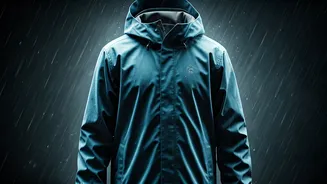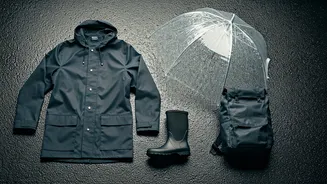

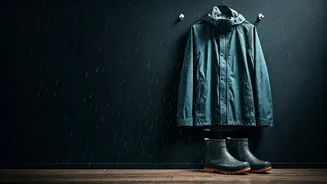


Water-Resistant vs. Waterproof: The Core Difference
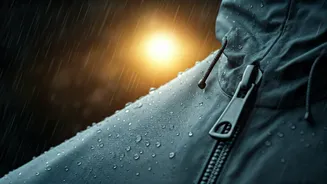
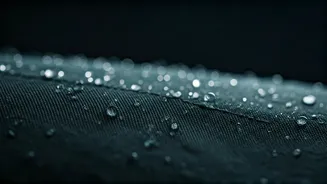
The first step is understanding that "water-resistant" and "waterproof" are not the same. Water-resistant jackets are typically treated with a coating called Durable Water Repellent (DWR), which makes water bead up and roll off. [1, 3, 8] This is fine
for a light drizzle, but in sustained rain, the fabric will eventually get saturated. [1, 2, 8] True waterproof jackets, on the other hand, have an internal membrane or coating that acts as a complete barrier to water. [4, 5] These are designed to keep you dry even in heavy downpours. For a jacket to be considered fully waterproof, it must also have taped or sealed seams to prevent water from leaking through the stitching holes. [2, 3]
Decoding Waterproof Ratings
To gauge a jacket's performance, manufacturers use a "hydrostatic head" (HH) rating, measured in millimetres (mm). [3, 4, 9] This test measures how much water pressure a fabric can withstand before it leaks. [4, 9] While a rating of 1,500mm is the minimum to be called waterproof, it won't stand up to much. A rating of 5,000mm is better for moderate rain, but for serious, all-weather protection, you should look for a rating of 10,000mm to 20,000mm. [3, 4] Anything in this higher range is built for heavy, sustained rain. [4]
Construction is King: Layers and Seams
Beyond ratings, a jacket's construction determines its durability. Raincoats are often described as 2-layer, 2.5-layer, or 3-layer. [2, 4, 8]
* **2-Layer:** These have an outer fabric bonded to a waterproof membrane, with a separate, comfortable mesh or fabric liner inside. They are durable but can be bulky. [2, 8]
* **2.5-Layer:** These are very lightweight and packable, featuring an outer fabric, a membrane, and a thin, printed or sprayed-on inner layer for protection. However, this inner layer is less durable and can feel clammy against the skin over time. [8]
* **3-Layer:** Here, the outer fabric, waterproof membrane, and a protective inner liner are all bonded together into a single, robust fabric. [2, 4, 8] This construction is the most durable and breathable, making it the choice for harsh conditions and long-term performance. [4, 8]
Don't Forget Breathability
A jacket that blocks rain but traps sweat will leave you wet from the inside. This is where breathability comes in. Waterproof-breathable fabrics, like the famous GORE-TEX and other similar technologies, use microscopic pores in the membrane. [5, 8] These pores are too small for water droplets to pass through from the outside, but large enough to let water vapour (your sweat) escape from the inside. [5, 8] For active use like hiking or cycling, good breathability is just as important as waterproofing. Features like underarm vents, or "pit zips," also provide extra ventilation when you're working hard. [3]
Making It Last: The Importance of Care
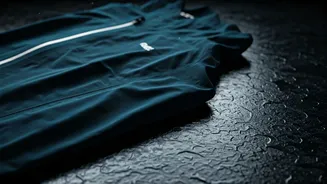
Even the best raincoat needs proper care. Over time, dirt, body oils, and abrasion can wear down the DWR coating, causing the outer fabric to absorb water—a phenomenon known as "wetting out." [15, 16, 17] When this happens, the jacket's breathability is severely reduced, making you feel damp and cold. [16] To maintain your jacket, wash it occasionally with a technical cleaner designed for waterproof clothing—never regular detergent, which can damage the membrane. [13, 17] After washing, the DWR can often be revived by applying low heat, such as a short cycle in the dryer (if the care label permits). [13, 16] If water no longer beads on the surface, it's time to reapply a DWR treatment, which can be done with a simple spray-on or wash-in product. [13, 15]