


The Data Deluge
Modern space science is facing a monumental challenge: a torrent of data. Telescopes like the James Webb and the now-retired Kepler, along with countless Earth-orbiting satellites, gather petabytes of information daily. This includes everything from high-resolution
images of distant galaxies to crucial climate data about our own planet. The sheer volume has outpaced the ability of human researchers to manually sift through it all. For years, potential discoveries have been hiding in plain sight within these massive archives. This data bottleneck is what makes artificial intelligence not just a helpful tool, but an essential partner for 21st-century science. By applying machine learning models, NASA can process and analyze this information at speeds previously unimaginable, turning a data problem into an opportunity for rapid discovery.
AI as the Autonomous Explorer
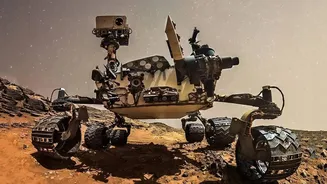
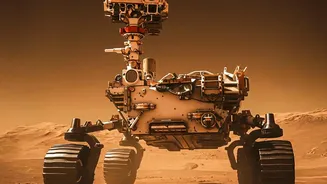
One of the most visible applications of AI is in the autonomy of its explorers. On Mars, the Perseverance rover relies heavily on AI to navigate the treacherous landscape. It autonomously identifies hazards like boulders and steep slopes, plotting its own safe path across terrain no human has ever seen. This capability is critical for missions where the communication delay between Earth and Mars makes real-time human control impossible. But AI's role extends beyond just driving. The rover’s instruments use machine learning to autonomously select rock samples for chemical analysis, searching for signs of ancient life without direct commands from mission control. This shift from remote-controlled robot to autonomous field scientist marks a significant evolution in planetary exploration.
From Sifting Data to Finding Planets
Beyond piloting spacecraft, AI is revolutionizing how discoveries are made. Astronomers have long struggled to distinguish real planets from false positives in the endless stream of data from planet-hunting telescopes. AI models like ExoMiner are trained to recognize the faint, tell-tale dimming of a star's light as a planet passes in front of it. By analyzing data from the Kepler and TESS missions, ExoMiner has already helped confirm hundreds of new exoplanets, some of which were missed by human analysts. These AI systems don't just find more planets; they find them faster and with greater accuracy, processing thousands of stars at once instead of the painstaking one-by-one analysis of the past. This accelerated pace of discovery is bringing us closer to answering fundamental questions about our place in the universe.
A New Era for Earth Science
NASA's AI push isn't just aimed at the stars; it's also focused on our home planet. The agency has partnered with companies like IBM to develop powerful AI foundation models trained on decades of Earth observation data. These tools can analyze satellite imagery to monitor deforestation, track the impact of wildfires, map floodwaters after a storm, and predict extreme weather events. As climate change intensifies, the ability to quickly transform satellite data into actionable insights is more important than ever. By making these AI models openly accessible, NASA is empowering a global community of scientists to better understand and protect our changing planet.
The Future Is a Partnership
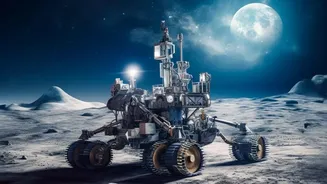
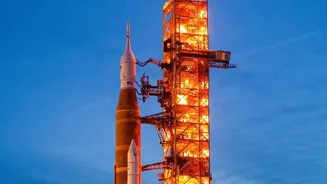
Looking ahead, NASA sees AI as an indispensable partner in its most ambitious goals, from the Artemis missions to the Moon to future deep-space voyages. The agency has established formal strategies and teams to integrate AI more deeply into every facet of its operations. This includes developing AI systems that can manage mission schedules, monitor spacecraft health to predict failures, and even assist with astronaut health on long-duration flights. As part of a whole-of-government initiative called the Genesis Mission, NASA is working to develop powerful AI tools that can connect data from different missions and even make novel discoveries on their own. The ultimate vision is one of autonomous science, where AI not only executes commands but actively participates in the process of discovery.