


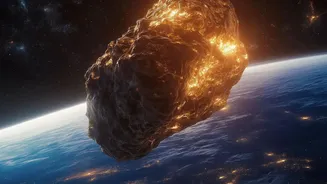
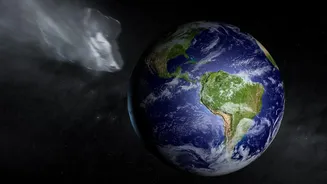
For the past few months, our Moon hasn't been our only natural satellite. A tiny, temporary visitor named 2026 QQ8 has been looping around our planet, and its brief stay is coming to an end. It's a reminder of how dynamic our cosmic backyard is.
Our Fleeting Second Moon
Earth
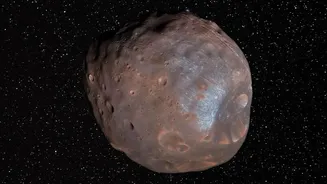
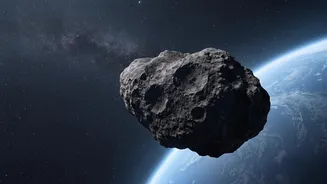
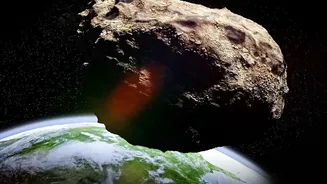
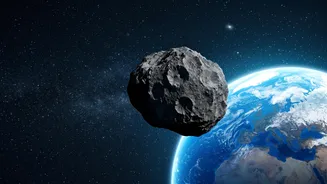
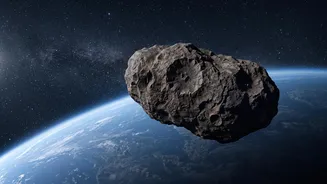
is about to say goodbye to its latest 'mini-moon'. A small asteroid, officially designated 2026 QQ8, was captured by our planet's gravity back in April of this year. This celestial passerby, estimated to be only about two metres in diameter, is expected to break free from Earth's orbit in early December. For several months, it has been a true, albeit tiny, natural satellite. The discovery was made in August by Hungarian astronomer Krisztián Sárneczky, and after weeks of observation to rule out the possibility of it being space debris, its natural origin as an asteroid was confirmed. While the term 'mini-moon' is an informal nickname, it perfectly describes these temporarily captured objects that offer a fascinating glimpse into the complex gravitational dance of our solar system.
What is a Mini-Moon?
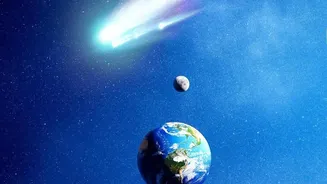
A mini-moon is an asteroid that gets temporarily snared by Earth's gravitational pull, forcing it into a chaotic and unstable orbit around our planet. Unlike our large, permanent Moon, these visitors don't stick around. Their time with us is fleeting, often lasting from a few months to a couple of years before the gravitational influence of the Sun and our main Moon slings them back into an orbit around the Sun. Think of it like a cosmic tourist. While most asteroids orbit the Sun, some have paths that bring them close to Earth. If one approaches at just the right speed and angle, our planet’s gravity can pull it in. These objects are typically very small—often the size of a car or even smaller—making them incredibly difficult to detect. Scientists believe there might be at least one mini-moon orbiting Earth at any given time, but their small size and speed make them elusive targets for even our most powerful sky surveys.
The Delicate Gravitational Dance
The reason 2026 QQ8 and other mini-moons can't stay for long is due to a cosmic tug-of-war. While Earth's gravity is strong enough to capture a passing asteroid, the Sun's gravitational pull is far more powerful. Add to that the constant gravitational nudges from our much larger, permanent Moon, and you have a recipe for orbital instability. Mini-moons follow complex, looping paths that can extend far beyond the Moon's own orbit. Eventually, these combined gravitational forces will perturb the mini-moon's trajectory, giving it the push it needs to escape Earth's influence and resume its journey as a sun-orbiting asteroid. In the case of 2026 QQ8, calculations show this departure is imminent, expected to happen within the first weeks of December.
Where Do They Come From and Go?
Most mini-moons are believed to originate from the main asteroid belt between Mars and Jupiter. Gravitational interactions, primarily with Jupiter, can kick these rocks into orbits that cross paths with Earth. Some theories also suggest that a portion of these objects could be fragments of our own Moon, blasted into space by ancient impacts. Once 2026 QQ8 leaves us, it will once again become a near-Earth object orbiting the Sun. Its new path will be slightly altered by its encounter with our planet. There's no danger of it colliding with Earth; at its small size, it would simply burn up harmlessly in the atmosphere, creating a bright meteor. Its journey highlights a constant, mostly invisible traffic of small bodies through our corner of the solar system, with past examples like 2006 RH120 and 2020 CD3 following similar capture-and-release patterns.
Why These Visitors Matter
Beyond the sheer novelty of having a second, temporary moon, these objects are of great scientific interest. Mini-moons are essentially pristine samples of asteroid material, delivered right to our cosmic doorstep. They are far more accessible for study than asteroids in the main belt or those requiring long-distance space missions. Studying their composition and trajectory helps astronomers refine their models of the solar system and better understand the population of near-Earth objects. With new, more powerful observatories like the Vera C. Rubin Observatory coming online, astronomers expect to find many more of these fleeting companions in the coming years. Each discovery provides another piece of the puzzle, helping us understand the history and dynamics of our solar system and offering potential targets for future robotic exploration.