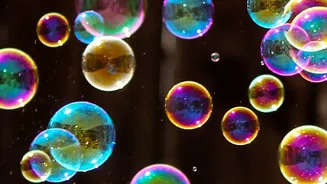





Have you ever tried to blow a square bubble? Despite using a square, star, or triangular wand, the bubbles that float away are always perfectly round. This isn't magic; it's a beautiful principle of physics at play in our everyday world.
The Hero of the Story: Surface Tension
The secret behind
a bubble's perfect roundness lies in a force called surface tension. Think of the surface of a liquid, like the soapy water of a bubble, as a thin, stretched elastic skin. The water molecules in this skin are strongly attracted to each other, pulling inward from all directions. This cohesive force creates a tension across the surface, constantly trying to shrink the surface into the smallest possible area. It's the same principle that allows tiny insects to walk on water; their weight isn't enough to break the tight network of molecules on the water's surface.
What is a Bubble, Really?
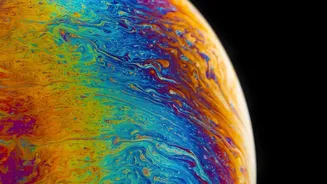
A soap bubble is an incredibly delicate structure: a very thin film of soapy water sandwiching a pocket of air. Pure water alone can't create stable bubbles because its surface tension is too high, causing it to collapse into droplets almost immediately. Adding soap is the key. Soap molecules have a unique structure with one end that loves water and another that repels it. When mixed, these soap molecules arrange themselves on the inner and outer surfaces of the water film, reducing the surface tension just enough to make the film flexible and strong, allowing it to stretch and hold its shape.
Nature’s Most Efficient Shape
So, why does this elastic film of soapy water form a sphere? The answer comes from a fundamental rule in nature: systems always try to use the least amount of energy possible. For a bubble, its energy is stored in the tension of its surface film; to minimize this energy, the bubble must minimize its surface area. Of all the three-dimensional shapes that can hold a certain volume of air, the sphere has the smallest possible surface area. A cube, a pyramid, or any other shape with corners and edges would require a larger surface area to enclose the same amount of air, and therefore more energy to maintain. The bubble, in its quest for the lowest energy state, naturally settles into the most efficient shape it can: a perfect sphere.
From Wand Shape to Perfect Sphere
This brings us back to our differently shaped wands. When you dip a square wand into soap solution, it holds a flat film of soapy water in a square shape. As you blow, you stretch this film, trapping air inside. For a fleeting moment, the bubble might have a distorted, wobbly shape as it detaches from the wand. But the instant it is free, surface tension takes over. The inward pull of the molecules acts equally across the entire surface, pulling the film into the shape with the minimum possible surface area. Any corners or edges are quickly pulled in, smoothing out into a curve. This process happens almost instantaneously, correcting the shape to a sphere where the forces of internal air pressure pushing out are perfectly balanced by the uniform inward pull of surface tension.