





Following the Water to the Fringes
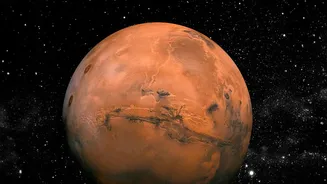
In the quest to find life beyond Earth, scientists operate on a simple principle: follow the water. Liquid water is the one essential ingredient for all life as we know it, and for years, that made Mars, with its dried-up riverbeds and polar ice caps,
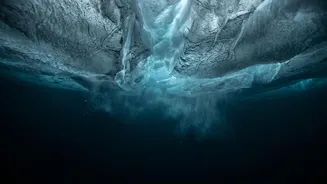
the prime target. But discoveries have broadened our horizons. Evidence now strongly suggests that some of the most voluminous oceans in our solar system aren't on planets at all, but are hidden deep beneath the frozen shells of moons orbiting Jupiter and Saturn. These are not small bodies of water; the ocean on Jupiter's moon Europa alone may contain more than twice the water of all of Earth's oceans combined. This paradigm shift has prompted space agencies to design a new generation of robotic explorers specifically to investigate these distant, icy worlds.
The Prime Suspects: Europa and Enceladus
Two moons have emerged as top-tier candidates: Jupiter’s Europa and Saturn’s Enceladus. Though their surfaces are frozen solid, multiple lines of evidence point to vast liquid oceans below. For Europa, data from the Galileo spacecraft showed disruptions in Jupiter's magnetic field that are best explained by a global, salty, and electrically conductive ocean. More recently, the Hubble Space Telescope has captured what appear to be massive plumes of water vapor erupting from its surface, hinting at a dynamic connection between the hidden ocean and space. Enceladus offers even more dramatic proof. The Cassini probe flew directly through plumes of icy particles jetting from fractures in the moon's southern pole, confirming they originated from a subsurface sea. These geysers effectively offer a free sample of the ocean's contents, making Enceladus a uniquely accessible target.
The Three Ingredients for Life
The excitement around these moons isn’t just about the water. Scientists believe these subsurface oceans may harbor all three key ingredients considered necessary for life: liquid water, essential chemical elements, and a source of energy. While sunlight can't penetrate the thick ice shells, another energy source is at play: tidal heating. The immense gravitational pull from their host planets, Jupiter and Saturn, constantly stretches and squeezes the moons. This process generates tremendous friction and heat in their cores, keeping the oceans liquid and potentially powering hydrothermal vents on the seafloor. On Earth, similar vents are bustling ecosystems, supporting life that thrives on chemical energy rather than sunlight. The interaction between the water and the rocky seafloor could also supply the necessary chemical nutrients, creating a potentially habitable environment.
A New Generation of Robotic Explorers
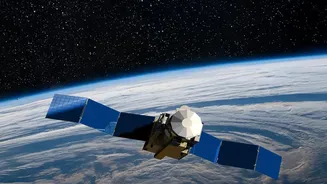
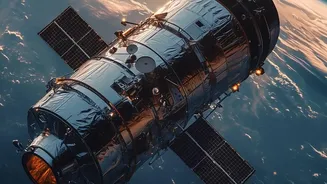
To investigate these tantalizing worlds, both NASA and the European Space Agency (ESA) have dispatched sophisticated missions. NASA's Europa Clipper, which launched in October 2024, will perform dozens of close flybys of Europa to characterize its ice shell, confirm the ocean's existence, and search for active plumes. Its main goal is to assess whether the conditions there could support life. Similarly, ESA's JUICE (Jupiter Icy Moons Explorer) mission, launched in April 2023, is on its way to study not only Europa but also two other potentially ocean-bearing moons, Ganymede and Callisto. Further out, NASA's Dragonfly mission, set to launch in 2028, will take a different approach. It will send a car-sized drone to Saturn’s largest moon, Titan. While Titan has a subsurface water ocean, Dragonfly will focus on exploring its surface, which is rich in complex organic molecules—the building blocks of life—that rain from its thick atmosphere. By flying between different locations, it will study the moon's prebiotic chemistry, offering clues about how life might begin.