

The Gentle Push of Light
The principle behind a solar sail is beautifully simple. Light, though it has no mass, is made of particles called photons that carry momentum. When a photon from the Sun hits a reflective surface, it bounces off, transferring a tiny amount of that momentum to the surface.
This transfer creates a minuscule but constant push known as solar radiation pressure. Over time, in the frictionless vacuum of space, these gentle pushes can accelerate a spacecraft to incredible speeds without using a single drop of propellant. Imagine a sailboat on a perfectly calm sea, catching a steady, unending breeze. That’s the core idea of a solar sail—a propulsion system with a fuel tank as big and as lasting as the Sun itself.
The Challenge of Precision Steering
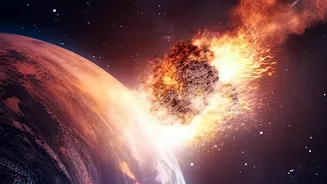
While the concept is simple, the execution is immensely complex. The force from photon pressure is incredibly weak, and a solar sail must be enormous—often the size of multiple basketball courts—and paper-thin to catch enough sunlight to be effective. This makes steering a major challenge. Traditional methods for controlling a spacecraft's orientation, like reaction wheels, can quickly become overwhelmed when trying to turn such a large, flimsy structure. This is especially problematic for missions that require precise navigation, like orbiting a small asteroid. The asteroid's own gravitational pull is weak and often irregular, making stable orbits notoriously difficult to maintain with a propulsion system that you can't easily throttle or aim.
A Breakthrough in Finesse
The true breakthrough isn't about generating more force, but about controlling it with unprecedented finesse. Instead of a single, monolithic discovery, this is a convergence of several clever attitude control technologies. Engineers are developing ways to steer the sail without relying solely on the main spacecraft bus. One method involves placing small, adjustable 'tip vanes' on the corners of the sail. By angling these mini-sails, the spacecraft can subtly alter the forces acting on the main sail, allowing for precise turns. Other concepts include shifting masses within the spacecraft to change its center of gravity or even using materials that can change their reflectivity on demand, effectively 'dimming' parts of the sail to create a turning force. These systems allow the spacecraft to actively manage the solar pressure for navigation, rather than just being pushed by it.
The Perfect Dance with an Asteroid
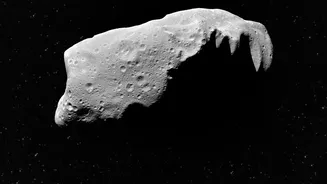
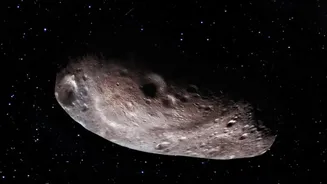
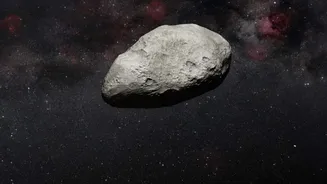
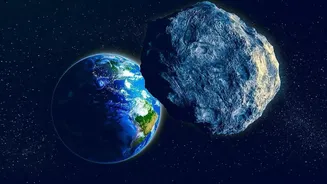
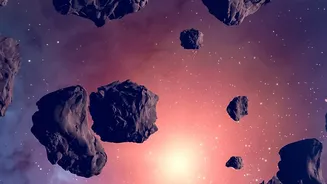
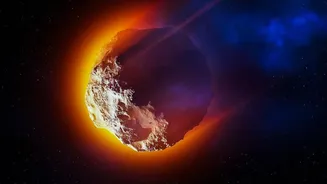
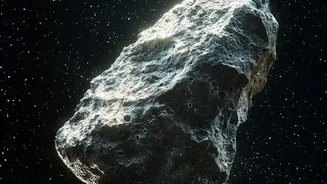
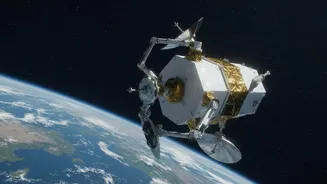
These advanced control systems make solar sails uniquely suited for exploring near-Earth asteroids. A conventional rocket would need to burn huge amounts of fuel to slow down and enter a stable orbit around such a small object. A solar sail, however, can do it propellant-free. By precisely tacking against the sunlight, it can gradually reduce its speed and spiral into a stable orbit. The new, highly responsive control methods allow the spacecraft to make the continuous, tiny adjustments needed to stay in the asteroid's weak gravitational grip for months or even years. This enables long-duration science missions, allowing a craft to map an asteroid's surface, study its composition, and search for resources—a feat that would be prohibitively expensive with traditional propulsion.
Unlocking the Future of Exploration
The ability to navigate 'effortlessly' near asteroids is just the beginning. By removing propellant as a limiting factor, advanced solar sails open up a new frontier of missions that were once considered impossible. Spacecraft could be designed to hop from one asteroid to another, surveying dozens of small bodies in a single mission. They could also be used for station-keeping, hovering at a fixed point between the Earth and the Sun to provide early warnings of solar storms. As the technology matures, these propellant-less systems are seen as a critical stepping stone toward more ambitious goals, including missions to the outer planets and even, one day, sending tiny probes to nearby star systems.