







A Mission to a Metal World
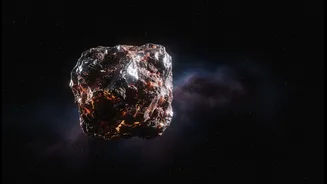
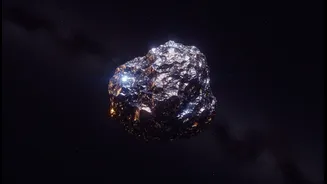
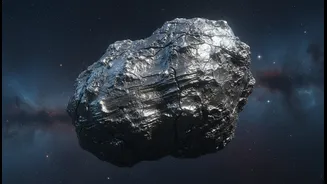
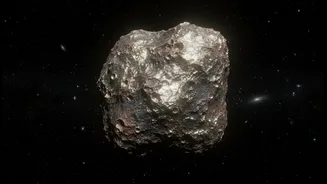
Deep in the asteroid belt between Mars and Jupiter orbits 16 Psyche, an object unlike most others we've explored. While many asteroids are piles of rock and ice, Psyche appears to be extraordinarily rich in metal. Scientists theorise it might be the exposed
iron-nickel core of a planetesimal, a small, early-stage planet that was smashed apart by violent collisions billions of years ago. Visiting Psyche offers a rare chance to study a planetary core, something we can't do on Earth, where our own core is buried under thousands of kilometres of rock. Launched in October 2023, NASA's Psyche spacecraft is on a long journey to rendezvous with this metal world in 2029. Its goal is to determine if Psyche is truly a planetary core or something else entirely, like a primordial body that never melted.
More Than Just a Phone Call Home
To study the asteroid, the spacecraft uses several instruments, but one of its most important investigations doesn't use a dedicated instrument at all. Instead, it relies on the spacecraft’s own communication system—its telemetry. Telemetry is the stream of radio waves sent between the spacecraft and the Deep Space Network on Earth. This stream carries vital health updates and scientific data from the probe's instruments. However, for the 'Gravity Science Investigation', the radio signal itself is the tool. By sending a signal from Earth to the spacecraft and having the spacecraft immediately send it back, scientists can measure the signal's properties with incredible precision. This is where the magic happens.
Weighing an Asteroid with Radio Waves
The key to this technique is the Doppler effect, the same phenomenon that makes an ambulance siren change pitch as it passes you. As the Psyche spacecraft orbits the asteroid, the asteroid's gravity will tug on it. These gravitational tugs cause minuscule changes in the spacecraft's speed and trajectory. These tiny speed changes, in turn, alter the frequency (or 'pitch') of the radio waves being sent back to Earth. By analyzing these frequency shifts, scientists at the Jet Propulsion Laboratory (JPL) can calculate the spacecraft's line-of-sight velocity to within fractions of a millimetre per second. This allows them to create an extremely precise map of the spacecraft's orbit. From that orbital data, they can calculate the total mass of the asteroid with unprecedented accuracy.
Mapping the Unseen Interior
But the investigation goes deeper than just finding the total mass. The headline's "density variables" refer to how that mass is distributed inside the asteroid. Is it a solid, uniform chunk of metal? Or is it more of a 'rubble pile' with denser regions and more porous, empty spaces? As the spacecraft orbits, any lumps or voids inside the asteroid will exert a slightly stronger or weaker gravitational pull, causing the probe to speed up or slow down ever so slightly in its orbit. These subtle 'wobbles' are detected in the telemetry data back on Earth. By mapping these gravitational variations as the probe orbits at different altitudes, scientists can construct a gravity field map of the asteroid. This map essentially allows them to peer inside Psyche, revealing its internal structure and helping to determine if it is a solid core or a mixture of metal and rock. This will help solve the puzzle of its density, which current estimates place somewhere between rock and solid iron, suggesting a mixed composition or high porosity.