





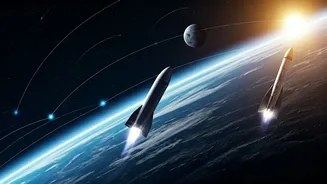


A New Race With New Rules
Forget the black-and-white images of the 1960s. Today's space race is a vibrant, multi-polar affair driven by a mix of national pride, geopolitical strategy, and immense commercial opportunity. It’s no longer just about planting flags and leaving footprints.
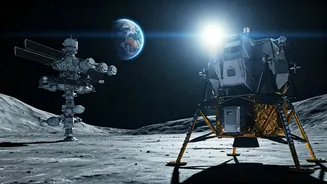
The new ambition is to stay. Nations like the United States, China, and India, alongside a host of private corporations, are looking at the Moon and beyond as places for permanent bases, resource extraction, and strategic outposts that could define power dynamics back on Earth. This contest involves a multitude of actors, including established spacefaring nations, emerging powers, and private companies like SpaceX and Blue Origin, all vying for a presence in Cislunar space—the region stretching from Earth to the Moon.
The US and China: Two Blocs, One Moon
The central rivalry is between the United States and China, each leading a coalition of international and commercial partners. The U.S. is spearheading the Artemis program, which aims to return humans to the lunar surface and establish a long-term presence. The crewed Artemis II mission successfully completed a lunar flyby in April 2026, marking humanity's farthest journey into space since the Apollo era. The first crewed landing in over 50 years is now planned for 2028 with Artemis IV. In response, China is leading the International Lunar Research Station (ILRS) initiative, with partners including Russia, Pakistan, and South Africa. Beijing has laid out an ambitious roadmap to establish a basic robotic lunar base near the south pole by 2035 and expand it into a comprehensive research network by 2050. This sets up a direct geopolitical rivalry, with both sides competing to secure strategic locations, particularly the lunar south pole, believed to be rich in water ice.
India and Other Powers Join the Fray
The competition extends well beyond the two superpowers. India has firmly established itself as a major player, becoming the first nation to land a spacecraft at the lunar south pole with its Chandrayaan-3 mission in 2023. The Indian Space Research Organisation (ISRO) has a slate of ambitious upcoming missions, including Gaganyaan, its first human spaceflight mission scheduled for the second half of 2026; a lunar sample-return mission (Chandrayaan-4); and a mission to Venus (Shukrayaan-1) planned for 2028. Furthermore, India plans to deploy its own modular space station, the Bharatiya Antariksh Station, by 2035 and is collaborating with Japan on a lunar polar exploration mission. More than 80 countries now have national space agencies, signaling a global shift.
The Commercial Frontier: LEO and Private Ambition
A defining feature of this new era is the rise of the private sector. Companies like SpaceX, Blue Origin, and Rocket Lab are no longer just contractors; they are key players driving innovation and building critical infrastructure. SpaceX's reusable rockets have drastically cut the cost of reaching orbit, enabling the deployment of massive satellite mega-constellations like Starlink in Low Earth Orbit (LEO). This has transformed LEO into a bustling commercial marketplace for global connectivity, Earth observation, and more, which is now valued at hundreds of billions of dollars. NASA itself is embracing this shift, planning to become a customer of commercially owned and operated space stations as the International Space Station nears retirement. This public-private partnership model is a cornerstone of the Artemis program, with companies developing the landers that will carry astronauts to the lunar surface.
The Stakes: Resources and Strategic Advantage
The frantic race to the Moon is fueled by the promise of valuable resources. The lunar surface contains water ice, which can be converted into rocket propellant, and rare earth elements crucial for modern electronics. Gaining access to these resources is seen as key to creating a sustainable, long-term presence in space and potentially a 'lunar gold rush'. Control over Cislunar space is also a significant military and strategic advantage. The technologies being developed for lunar settlement—from heavy-lift rockets to in-space resource processing—have dual-use potential that could redefine capabilities in Earth orbit, where military competition is already active. This competition is unfolding in a legal gray area, as the 1967 Outer Space Treaty prohibits national sovereignty claims but is unclear on resource extraction.