


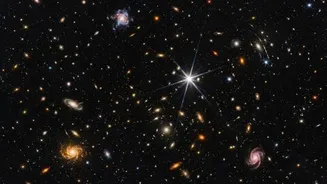
Seeing the Invisible
Imagine trying to take a picture through a thick fog. Visible light, the kind our eyes see, gets scattered and blocked. For astronomers, interstellar dust and gas create a similar problem on a cosmic scale, obscuring the view of crucial regions like the centers
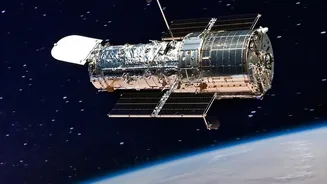
of galaxies and the birthplaces of stars. Infrared light, however, is a game-changer. Its longer wavelengths can pass straight through these dense clouds, much like a radio signal passes through the walls of a building. Telescopes designed to capture this infrared radiation, like the James Webb Space Telescope (JWST), are not just taking clearer pictures; they are seeing parts of the universe that were previously completely invisible to us. This allows scientists to study phenomena like the formation of new stars and planets, which happen deep inside dusty nebulae.
Unveiling Galactic Nurseries
Some of the most profound questions in astronomy involve how stars are born. These stellar nurseries are almost always shrouded in the very dust and gas from which the stars form, making them impossible to study in detail with traditional optical telescopes. Infrared imaging cuts through this veil. Recent observations from the JWST have provided unprecedented views inside these regions, showing young stars in their earliest stages of development. By analyzing the heat signatures captured in infrared, astronomers can map the structure of these star-forming clouds and even detect the swirling disks of material around newborn stars where planets might be forming. These fresh observations are providing a much clearer picture of the lifecycle of stars and the creation of planetary systems.
Challenging Theories of the Early Universe
Perhaps the most startling revelations from recent infrared observations concern the very early universe. Because light takes time to travel, looking at the most distant galaxies is like looking back in time. The JWST was built to find the very first galaxies that formed after the Big Bang. What it has found is forcing a major rethink. Recent discoveries have identified galaxies that are surprisingly large, bright, and chemically mature for their age, appearing just a few hundred million years after the universe began. According to many existing models, there simply shouldn't have been enough time for galaxies to grow so massive or for stars to produce heavier elements. These 'impossible' galaxies suggest that the processes of galaxy formation in the early cosmos were far more efficient and rapid than previously believed, sending theorists back to the drawing board.
Solving the Mystery of Cosmic Dust
While infrared light helps us see through dust, it also helps us understand the dust itself. A key puzzle in cosmology is where all the dust in the early universe came from. Using the JWST, astronomers recently studied a nearby galaxy to understand how cosmic 'factories' pumped the infant cosmos full of the elements that make up dust. This is crucial because dust is a key ingredient for forming new stars and planets. Other recent discoveries include hundreds of small, faint 'Little Red Dots' (LRDs), which are thought to be primordial galaxies from the first billion years of the universe. Studying these objects helps astronomers understand the reionization epoch, a key cosmic makeover where neutral gas in the universe became ionized. Tiny, low-mass galaxies are now thought to have been powerful enough to drive this transformation.