

Searching for Life’s Chemical Fingerprints
When scientists hunt for life on distant exoplanets, they're not looking for little green men. Instead, they search for 'biosignatures'—gases in a planet’s atmosphere that are likely produced by living organisms. By analysing the light from a planet's
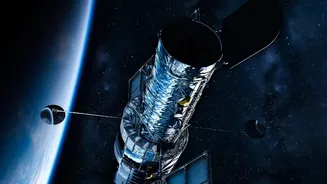
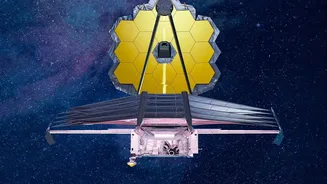
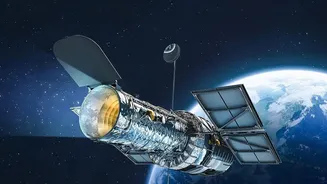
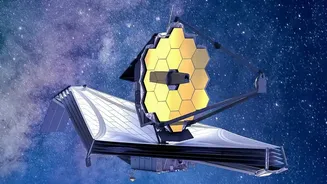
star as it passes through its atmosphere, instruments like the James Webb Space Telescope (JWST) can identify the chemical makeup of that atmosphere. For decades, oxygen has been a top candidate, but scientists are now realising that a specific pairing of other gases could be an even more compelling sign of a living world.
Methane: A Promising but Tricky Sign
Methane is an exciting find because, on Earth, the vast majority of it is produced by life, from microbes in wetlands to our own digestive systems. However, finding methane alone isn't proof of life. Geological processes, such as volcanic activity or reactions between water and certain rocks, can also produce methane abiotically (without life). Furthermore, methane is chemically unstable in an atmosphere; it's broken down by starlight. This means that for methane to be detectable, something must be constantly replenishing it, which is a tantalising hint in itself.
Carbon Dioxide: Providing Crucial Context
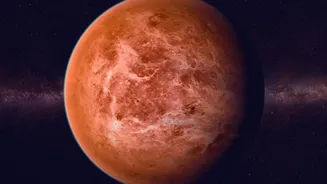
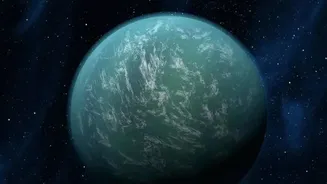
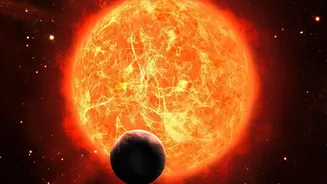
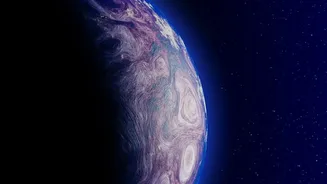
Carbon dioxide (CO2) is another key piece of the puzzle. On Earth, it's central to the carbon cycle of life, used by plants for photosynthesis and exhaled by animals. Finding it in an exoplanet's atmosphere suggests the planet might have the basic building blocks for life as we know it. Recent JWST observations of the exoplanet K2-18 b, for instance, revealed the presence of both methane and carbon dioxide. This discovery has intensified interest in the planet, which orbits in its star's habitable zone where liquid water could potentially exist.
The Power of the Pair
The real magic happens when methane and carbon dioxide are found together. This combination suggests a state of 'atmospheric disequilibrium'. In simple terms, these two gases shouldn't really coexist in large amounts in a stable atmosphere because they represent opposite ends of a chemical spectrum. Methane is reduced (hydrogen-rich), while carbon dioxide is oxidised (oxygen-rich). Without a constant, active source, they would react and balance out. Finding both in large quantities is like walking into a room and seeing a running tap and an open drain; you know something active is happening to keep the system in that state. Life is exceptionally good at creating and maintaining such chemical imbalances.
Not a Guarantee, But a Strong Hint
It is crucial to note that this is not yet definitive proof of life. Scientists must be meticulous in ruling out any non-biological process that could mimic this signature. For example, a key indicator would be the absence of significant amounts of carbon monoxide (CO). Many abiotic processes that produce methane and CO2 would also generate CO, whereas many biological processes would consume it. Therefore, an atmosphere rich in methane and CO2 but poor in CO is considered a much stronger biosignature. The detection on K2-18 b also included a possible hint of dimethyl sulfide (DMS), a molecule that on Earth is only produced by life, adding another layer of intrigue.