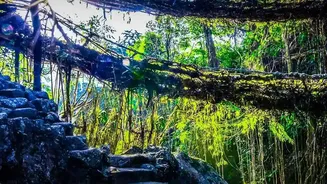








Deep in the misty hills of Meghalaya, an extraordinary example of natural architecture thrives. These are not bridges built of steel or stone, but grown from living trees, a testament to a unique partnership between humanity and nature.
A Bridge That Breathes
In the dense, subtropical
rainforests of northeast India, the Khasi and Jaintia peoples have mastered a form of bioengineering that seems drawn from fantasy. They create bridges, known locally as 'Jingkieng Jri', not by construction, but by cultivation. The headline is indeed correct: these structures are coaxed into existence from the roots of a rubber tree. Specifically, they are formed from the aerial roots of the Ficus elastica, also known as the Indian rubber fig tree. This remarkable tree sends down strong, pliable roots from its branches, which, with a helping hand, can be guided across raging rivers and steep gorges to create a living, growing pathway. Unlike concrete and steel, these bridges become stronger with age, merging with the landscape and supporting the communities that nurture them.
The Art of Growing a Crossing
The creation of a living root bridge is an act of profound patience and generational knowledge. The process begins with identifying a healthy Ficus elastica tree on a riverbank. Villagers then use various ingenious methods to guide the young, flexible aerial roots towards the opposite bank. Often, they use hollowed-out trunks of areca nut palms as scaffolding, feeding the roots through these organic tunnels. The trunks protect the delicate roots and provide nutrients as they decompose. Alternatively, bamboo scaffolding is erected across the river, and the roots are carefully wrapped around it. This framework guides the roots horizontally until they can anchor themselves in the soil on the other side. The process is slow, taking anywhere from 15 to 30 years for a bridge to become fully functional.
Generations of Indigenous Ingenuity
For centuries, the Khasi and Jaintia tribes have passed down the skills needed to create and maintain these vital connections. The bridges are a communal effort, a perpetual work in progress that bonds the community together. As the roots grow, they are woven and twisted together, sometimes fusing in a natural process called inosculation to form a strong, intricate lattice. These structures are incredibly resilient, able to withstand the region's powerful monsoons, which can easily destroy conventional bridges. Some of the most famous examples, like the stunning double-decker bridge in Nongriat, are estimated to be around 200 years old, capable of holding the weight of 50 people at once. These bridges are more than just infrastructure; they are a living inheritance.
A Symbol of Sustainable Living
In an era of rapid, often unsustainable development, the living root bridges of Meghalaya offer a powerful lesson. They represent a harmonious relationship between people and the planet, a philosophy of working with nature rather than against it. These structures are essential for connecting remote villages, allowing children to get to school and farmers to reach markets. Recognizing their immense cultural and ecological value, India has nominated the 'Jingkieng Jri' for UNESCO World Heritage status. This move aims to bring global recognition to the indigenous communities who are the true guardians of this heritage and to support the preservation of their unique skills and way of life for generations to come.