



A Familiar Galaxy Transformed
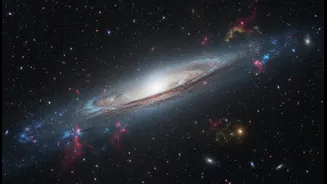
To celebrate its fourth anniversary of scientific operations, NASA released a breathtaking new image of Centaurus A, and it’s unlike anything we’ve seen before. Located about 11 million light-years away, this galaxy has long been a favourite target for astronomers.
But where previous images showed a bright elliptical galaxy sliced in half by a dark, thick band of dust, Webb’s view transforms it. We now see a sparkling, complex tapestry of millions of individual stars, glowing gas, and intricate dusty structures that were previously hidden. The dark slash of dust is no longer a void, but a vibrant region now visible for the first time.
What is Centaurus A?
Centaurus A is not your average, quiet galaxy. It is known as an active galaxy, meaning its core is unusually energetic. At its heart sits a supermassive black hole, actively consuming surrounding material and blasting out enormous jets of energy. This galaxy also has a violent past. Its peculiar shape is the result of a colossal cosmic collision that occurred roughly two billion years ago, when a large elliptical galaxy merged with a smaller spiral galaxy. This galactic smash-up left behind the warped, dusty disc we see today and triggered waves of new star formation, making it a perfect natural laboratory for studying how galaxies evolve.
The Power of Infrared Vision
So, why does Webb’s picture look so different from the ones taken by the Hubble Space Telescope? It all comes down to the kind of light they see. Hubble primarily observes in visible and ultraviolet light, the same kind our eyes detect. While this is perfect for capturing stunning details of many cosmic objects, it’s blocked by cosmic dust—much like how smoke can obscure our view of a distant object. The James Webb Space Telescope, on the other hand, is designed to see in infrared light. Infrared wavelengths can pass straight through these dense dust clouds, allowing Webb to see what lies behind the veil. This capability is crucial for understanding the hidden processes at the heart of dusty galaxies like Centaurus A.
Piercing the Dusty Veil
Previous infrared telescopes, like the retired Spitzer Space Telescope, could sense the warm glow of dust in Centaurus A but lacked the sharpness to see fine details. Webb combines this infrared sensitivity with incredible resolution. The new images cut through the opaque dust lanes to reveal the galaxy's core with stunning clarity. What once looked like a hazy, grainy area is now resolved into a densely packed field of individual stars. This allows astronomers to perform a kind of galactic archaeology; by studying stars of different ages, they can reconstruct the galaxy's history—identifying which stars existed before the merger, which were born during the chaotic collision, and which formed in the aftermath.
Uncovering Cosmic Secrets
This unprecedented view is more than just a pretty picture. It offers new clues to some of astronomy's biggest questions. For instance, how does a supermassive black hole influence its entire host galaxy? Webb’s observations reveal the complex interplay, showing how the black hole’s energetic jets can both trigger star birth by compressing gas and limit it by blowing material away. Scientists can now trace intricate filaments and loops of glowing dust and gas sculpted by the black hole’s activity and the ancient merger. By seeing individual stars, they can map the galaxy’s past and better understand the powerful forces that shape the cosmos.