



The Two Key Ingredients: Gravity and Speed
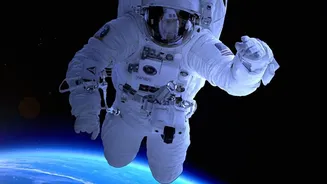
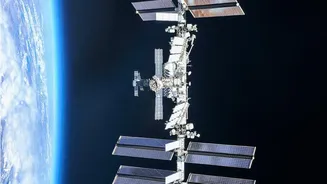
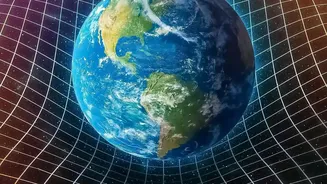
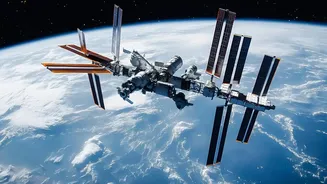
The first thing to get straight is that gravity is very much active in space. Astronauts on the International Space Station (ISS) appear weightless, but they are still under about 90% of the gravitational pull you feel on the ground. The station, and
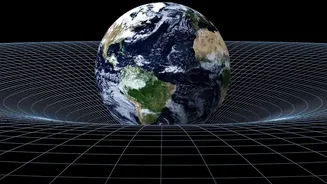
everything in it, is constantly being pulled toward Earth. So, what stops it from crashing? The answer is its incredible forward velocity. The ISS travels at roughly 17,500 miles per hour (about 5 miles per second). This immense sideways speed is the crucial second ingredient. It’s the perfect combination of these two forces—gravity pulling down and inertia wanting to keep the spacecraft moving forward in a straight line—that creates a stable orbit.
The 'Falling and Missing' Analogy
The best way to understand an orbit is to think of it as continuously falling toward a planet but moving so fast sideways that you constantly miss it. More than 300 years ago, Isaac Newton devised a brilliant thought experiment to explain this, now known as 'Newton's cannonball'. He imagined a cannon on top of a very tall mountain, high enough to be above the atmosphere, so there's no air resistance. If you fire a cannonball with a low speed, it travels a short distance before gravity pulls it to the ground. If you fire it much faster, it travels farther before landing. But, Newton realized, if you could fire it at a specific, blisteringly fast speed, the cannonball's path would curve downward at the exact same rate that the Earth's surface curves away beneath it. The cannonball would still be falling, but it would never get any closer to the ground. It would be in orbit.
What 'Constant' Velocity Really Means
The headline's 'constant forward velocity' is a useful starting point, but the reality is a little more nuanced. For a perfectly circular orbit, a satellite must maintain a very specific, constant speed. For the ISS, that speed is about 17,150 mph. If it slows down, gravity will win the tug-of-war, and its orbit will decay, causing it to spiral back toward the atmosphere. If it speeds up too much, it will overcome gravity's pull and fly off into a higher orbit or even escape Earth's gravity altogether. Interestingly, satellites in higher orbits actually travel slower than those in lower orbits because the pull of gravity is weaker farther away. For example, a communications satellite in a geostationary orbit 22,000 miles up travels at 'only' about 6,700 mph to stay in its path.
No Constant Engine Firing Needed
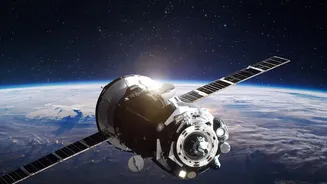
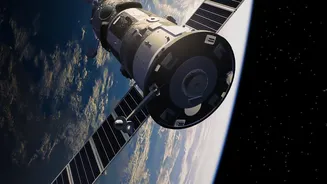
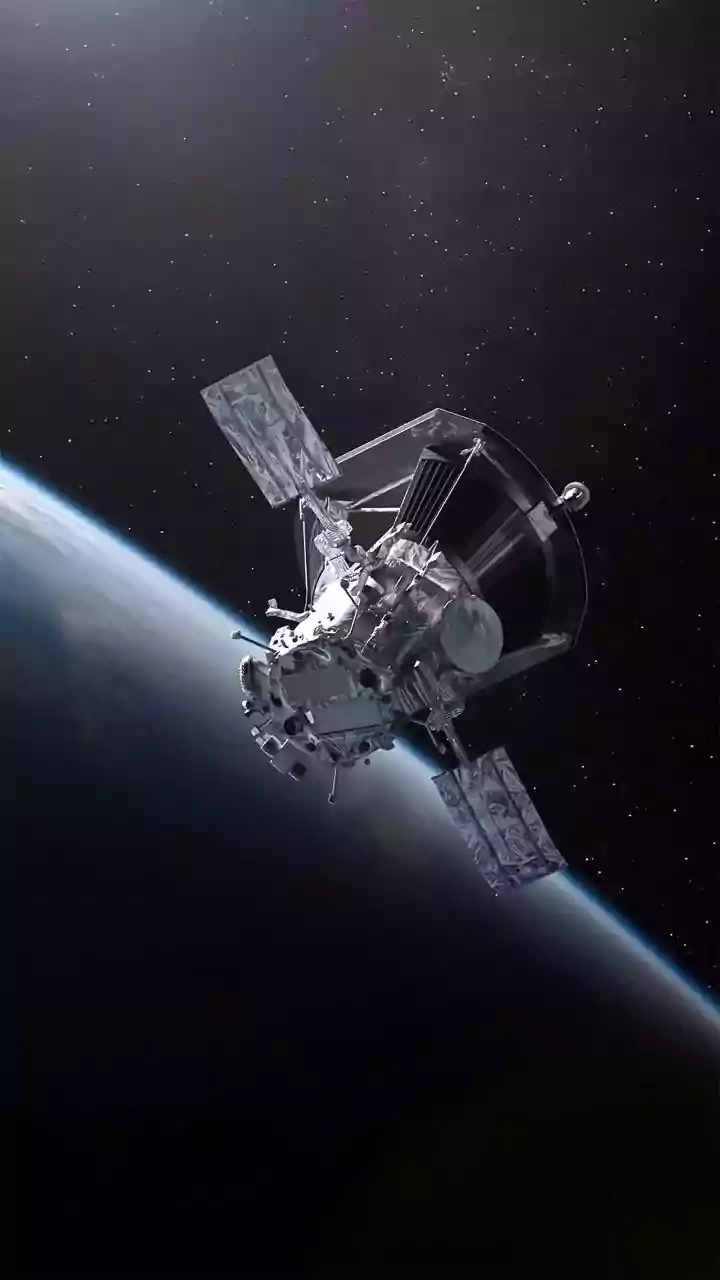
A common misconception is that a spacecraft must constantly fire its engines to maintain this speed. Thanks to Newton's first law of motion (inertia), once an object is in motion, it stays in motion unless acted upon by an outside force. In the near-vacuum of space, there is almost no atmospheric drag to slow a satellite down. After the initial boost from a rocket to get it to the right altitude and speed, a satellite largely just coasts. Its momentum from the launch is enough to keep it moving forward, while Earth's gravity provides the centripetal force that continuously bends its path into an orbit. The small amounts of fuel satellites carry are not for maintaining speed but for making occasional adjustments to their orbit, changing altitude, or avoiding space debris.