

The Universe’s Missing Middle Child
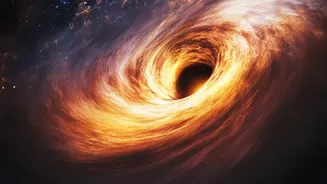
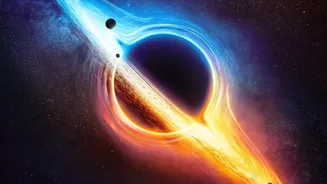
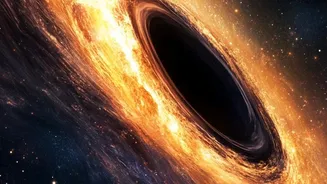
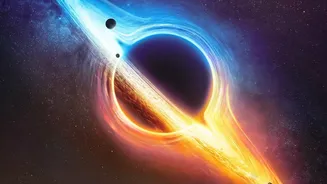
Imagine the universe of black holes as having two main families. First, you have the stellar-mass black holes, which are typically 5 to 100 times the mass of our Sun. They are the relatively common remnants of giant stars that have collapsed under their
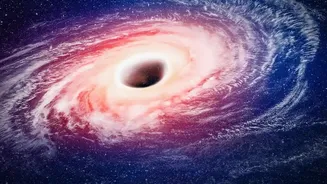
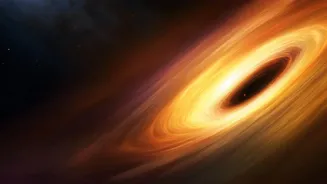
own gravity. At the other extreme are the supermassive black holes, behemoths weighing millions or even billions of times our Sun’s mass, which anchor the centers of most large galaxies like our own Milky Way. But what about everything in between? For years, astronomers have theorized about, but struggled to find, intermediate-mass black holes (IMBHs). These objects, with masses ranging from 100 to 100,000 times that of the Sun, were a crucial but missing piece of the puzzle, the cosmic middle child whose absence made it difficult to explain how supermassive giants grow so large.
Listening to the Echoes of a Collision
Finding an IMBH is hard enough; detecting two of them merging is a monumental achievement. These events are not ‘seen’ with traditional telescopes but ‘heard’ through the fabric of spacetime itself. Observatories like the Laser Interferometer Gravitational-Wave Observatory (LIGO), Virgo, and KAGRA act like giant, ultra-sensitive ears. When two massive objects like black holes spiral into each other and collide, they send out powerful ripples in spacetime called gravitational waves. These waves travel across the universe at the speed of light. By the time they reach Earth, the distortions are smaller than the width of a proton. Yet, the incredibly precise instruments at these observatories can detect this faint tremor, allowing scientists to reconstruct the cosmic cataclysm that created it, including the mass and spin of the objects involved. The detection of mergers that result in a new black hole within the IMBH mass range is the smoking gun scientists have been searching for.
From Middleweight to Heavyweight Champion
The detection of IMBH mergers provides direct evidence for a theory known as hierarchical merging. The idea is simple: black holes can grow by eating other black holes. A stellar-mass black hole can merge with another, and another, and another, gradually building its mass. The product of a merger between two stellar-mass black holes could easily become an IMBH. For example, a merger of an 85-solar-mass black hole and a 66-solar-mass one resulted in a new 142-solar-mass black hole, firmly in the intermediate category. This process suggests that IMBHs are not just a separate class of object but a key stepping stone. They are the adolescent phase in a black hole’s life, demonstrating how small black holes born from stars can eventually grow into the supermassive giants that dominate galaxies.
Rewriting the Story of the Cosmos
Unlocking the secrets of IMBHs does more than just fill a gap in our black hole catalogue. It fundamentally changes our understanding of how galaxies themselves are built. The prevailing theory is that supermassive black holes and their host galaxies grow together, but the origin of the supermassive 'seeds' was a mystery. Did they form from the collapse of gigantic gas clouds in the early universe, or did they grow from smaller black holes? The confirmation of IMBH mergers strongly supports the latter 'bottom-up' model. It suggests that the first star clusters and small dwarf galaxies formed their own IMBHs through repeated mergers. Over cosmic time, these smaller galaxies collided and merged, and their central IMBHs merged as well, eventually creating the supermassive black holes we see today. Each gravitational wave detection from these events is like finding another page from the universe's autobiography, telling us the story of its own evolution.