




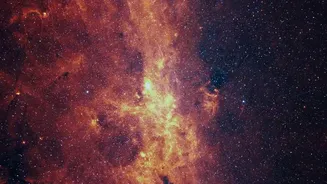
A Whisper from the Dawn of Time
Imagine trying to hear a single pin drop in a stadium during a rock concert. That’s the scale of the challenge astronomers faced, and have now overcome. The newly detected signals are whispers from a period known as the 'Cosmic Dawn', which occurred a few
hundred million years after the Big Bang. During this era, the universe was filled with a vast fog of neutral hydrogen gas, long before the first stars and galaxies had fully formed to light it up. The signals are incredibly faint, having travelled across the vastness of space and time to reach us. Their detection marks a monumental achievement in radio astronomy and opens a new window into a previously invisible chapter of cosmic history.
What is the Square Kilometre Array?
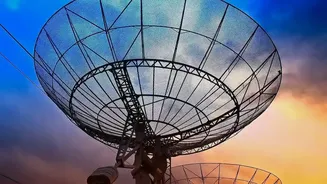
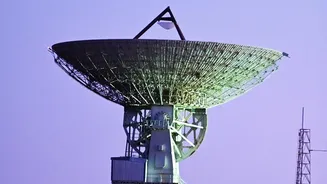
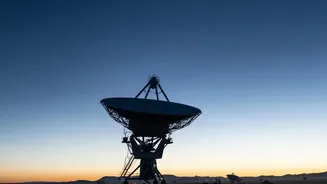
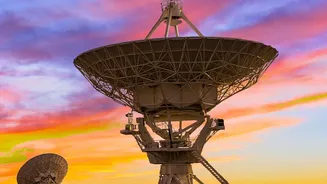
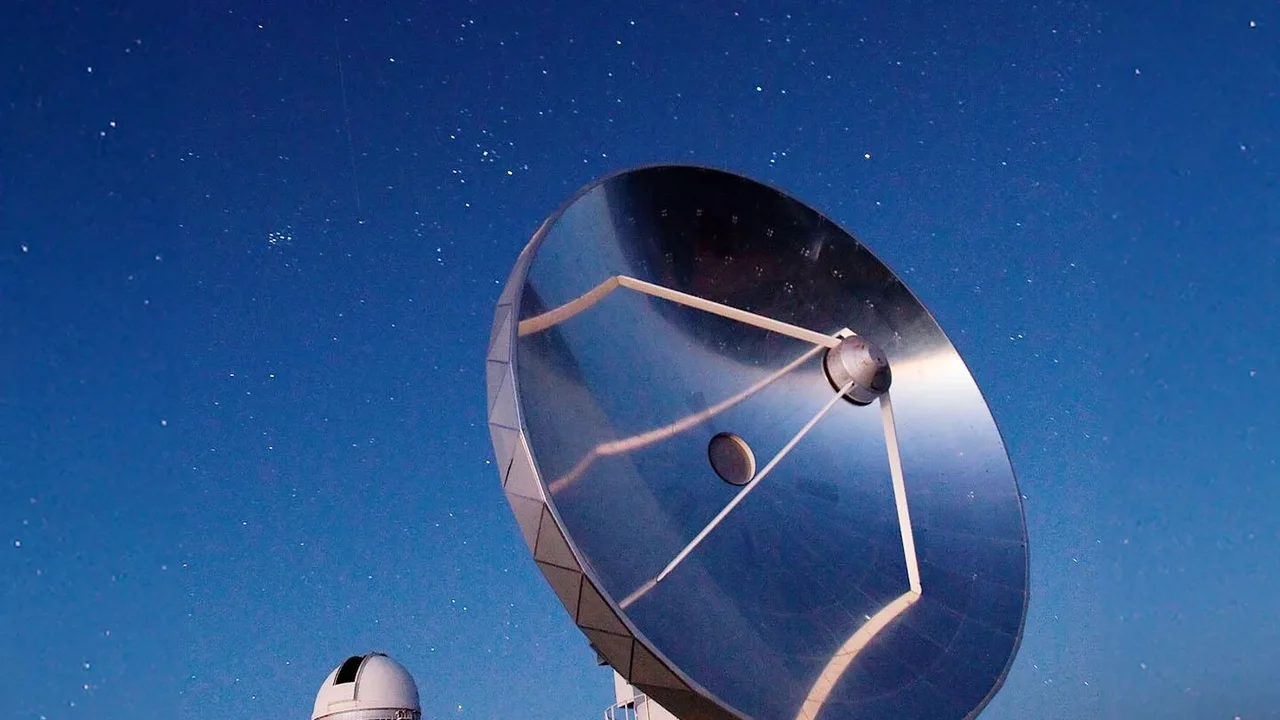
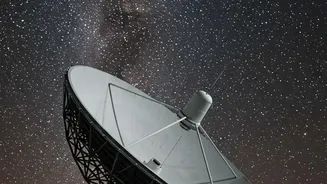
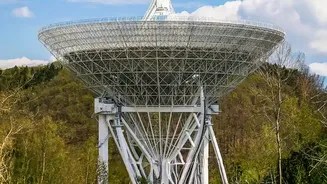
The SKA is not just one telescope, but a revolutionary global project building the world's largest radio observatory. It consists of two main arrays: SKA-Low in Western Australia, which will feature over 130,000 Christmas tree-like antennas, and SKA-Mid in South Africa, which will use hundreds of large dishes. Together, they will form a single, colossal telescope with a collecting area of one square kilometre, making it the most sensitive instrument of its kind ever built. This immense sensitivity is precisely what’s needed to pick up the extraordinarily weak radio waves from the edge of the observable universe. Construction began in 2022, and this first detection shows the incredible potential of the observatory even in its early stages.
Hunting the 'Holy Grail' 21-cm Signal
The signal that astronomers have been hunting is known as the 21-centimetre line. This is a specific radio frequency emitted by neutral hydrogen atoms—the most abundant element in the early universe. As the first stars began to ignite, their ultraviolet light warmed and ionized the surrounding hydrogen gas, creating bubbles that eventually merged and made the universe transparent. This period is called the Epoch of Reionization. The 21-cm signal holds the imprint of this entire process. By studying how this signal changes over time, scientists can create a 3D map of the early universe, effectively watching the first stars switch on and seeing how the first galaxies grew. It's the closest we can get to having baby pictures of the cosmos.
India’s Crucial Role in the Discovery
This global success story has a significant Indian chapter. India is a full member of the SKA Organisation, with the National Centre for Radio Astrophysics (NCRA) in Pune leading a consortium of over 20 national institutes. The Indian government has committed ₹1,250 crore to the project. Indian scientists and engineers have played a pivotal role, particularly in developing the Telescope Manager—the complex 'brain' and nervous system of the entire observatory. Furthermore, India is contributing to the digital signal processing hardware for the SKA-Low telescope and will host a regional data centre to process the immense volumes of data the SKA will generate. This involvement builds on India's rich legacy in radio astronomy, including the world-renowned Giant Metrewave Radio Telescope (GMRT) near Pune, which itself is a key pathfinder for the SKA.
What Comes Next?
This detection is just the beginning. As more of the SKA comes online, its sensitivity will increase dramatically, allowing for more detailed observations. Scientists will be able to move from detecting a faint, average signal to creating detailed maps of the hydrogen fog as it was being burned away by the first starlight. This will help answer some of the biggest questions in cosmology: What were the first stars like? How did the first black holes form and grow? How did the vast cosmic web of galaxies we see today emerge from a uniform, dark universe? The SKA will provide the data to test our theories about cosmic evolution in unprecedented detail, potentially revolutionising our understanding of the universe.