



The Threat: Solar Eruptions
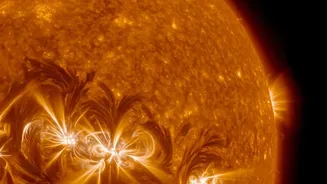
Our modern lives depend on a vast network of technology, from GPS navigation and communications satellites to stable power grids. All of these are vulnerable to what scientists call 'space weather'. The biggest drivers of dangerous space weather are eruptions
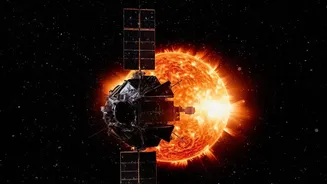
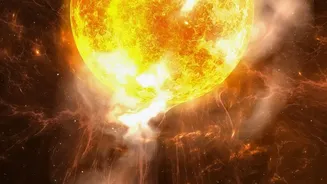
from the Sun, like solar flares and Coronal Mass Ejections (CMEs). A CME is a gigantic explosion of magnetised plasma from the Sun's outer atmosphere, the corona, that hurtles through space. If one of these is aimed at Earth, it can trigger a geomagnetic storm, which has the potential to damage satellites, disrupt radio communications, and even cause widespread power outages. These events also release bursts of high-energy particles, creating the solar radiation spikes mentioned in the headline.
The Challenge: Staring Into the Sun
Predicting these events means we have to watch the Sun constantly. But there's a problem: the Sun is blindingly bright. Its visible surface, the photosphere, is a million times brighter than its faint outer atmosphere, the corona, where CMEs are born. Trying to spot a faint eruption beginning in the corona is like trying to see a candle flicker next to a stadium floodlight. To get a clear view of the corona and the birth of a CME, scientists need a way to block out the Sun's intense glare without blocking the light from the atmosphere around it.
The Solution: A Man-Made Eclipse
This is where the coronagraph comes in. Invented by Bernard Lyot in 1931, a coronagraph is a special telescopic instrument designed to create an artificial solar eclipse. It uses a precisely placed solid disk, called an occulting disk, to block the direct light from the Sun's main body. By blocking the photosphere, the much fainter corona becomes visible, allowing scientists to study its structure and watch for explosive events. While ground-based coronagraphs exist, they are hampered by light scattering in Earth's atmosphere. Satellite-based coronagraphs, operating in the vacuum of space, provide a much clearer and continuous view.
How Satellites Use Coronagraphs for Prediction
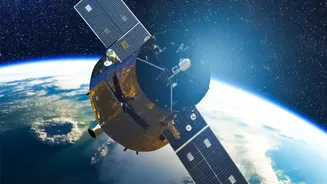
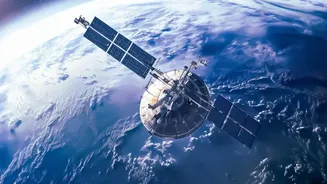
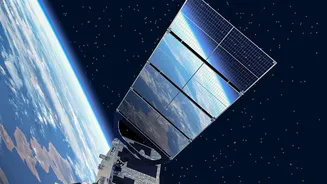
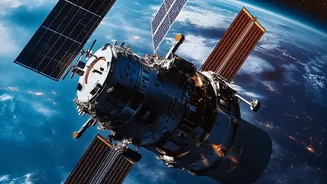
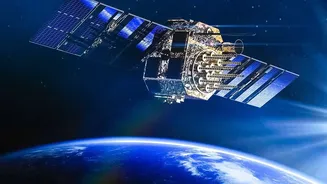
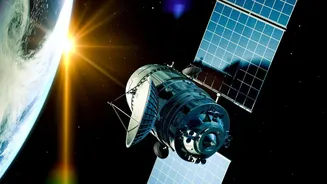
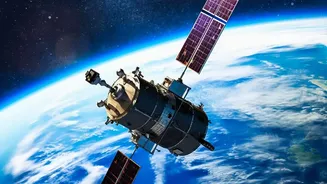
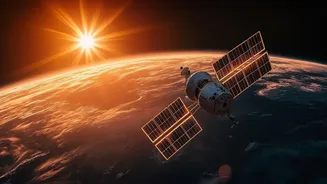
Advanced space weather satellites, such as the joint NASA/ESA SOHO spacecraft and NOAA's new SOLAR-1, are positioned at a special point in space called Lagrange Point 1 (L1), about 1.5 million km from Earth. From this vantage point, they have an uninterrupted view of the Sun. Their onboard coronagraphs take a constant stream of images of the solar corona. When a CME erupts, it appears in these images as a massive, expanding cloud of material moving away from the Sun. By analysing a sequence of these images, forecasters at agencies like NOAA’s Space Weather Prediction Center can determine the CME's size, speed, and direction. This information is then fed into computer models, like the WSA-Enlil model, to predict if and when the CME will impact Earth and how intense the resulting geomagnetic storm might be.
India’s Eye on the Sun: Aditya-L1
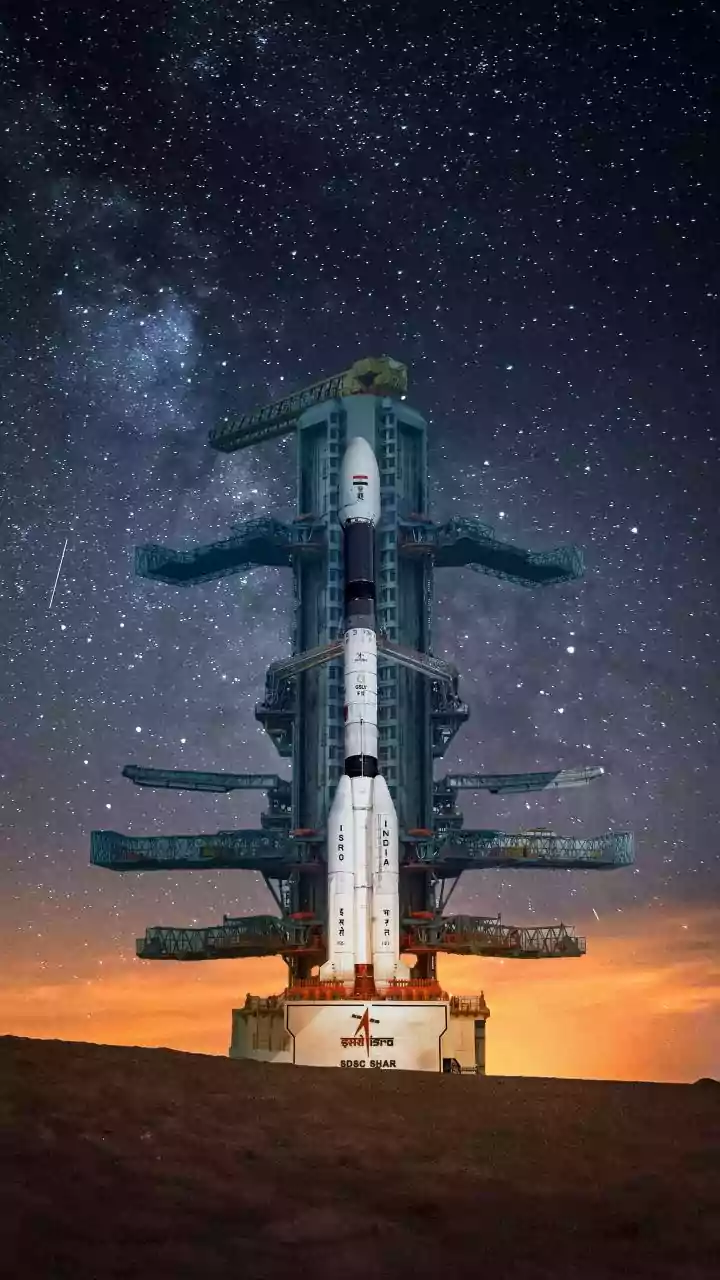
India has become a key player in this global effort with its own solar observatory, Aditya-L1. Launched by ISRO, Aditya-L1 is also positioned at the L1 point and is equipped with seven payloads to study the Sun. Its primary instrument is the Visible Emission Line Coronagraph (VELC), designed to study the solar corona with high precision. By providing continuous observations of CMEs and other solar dynamics, Aditya-L1 is not only contributing vital data to the global understanding of space weather but is also crucial for protecting India’s own growing space assets and ground-based technological infrastructure. The mission enhances our ability to understand the physics of the solar corona and improve space weather forecasting.
From Images to Early Warnings
The time between a CME being spotted by a coronagraph and its arrival at Earth can be anywhere from less than a day to several days, depending on its speed. This provides a critical window of warning. Newer satellites like SOLAR-1 can deliver CME imagery to forecasters within 30 minutes, a vast improvement over the hours it took with older systems. This lead time allows satellite operators to put their spacecraft into a safe mode, power companies to prepare their grids for potential electrical surges, and airlines to reroute flights away from polar regions where radiation exposure is higher during solar storms. It gives us a chance to brace for the impact of the Sun's fury and protect the technology our world runs on.