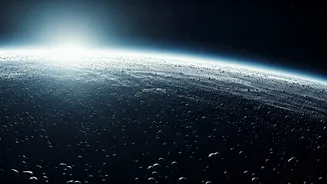




Not Rocks, But Glistening Ice
Let's start with a friendly correction to the headline. While the rings do contain rocky material and dust, calling them 'floating rocks' is a massive oversimplification. The reality is far more beautiful and strange. Over 99% of what you see in Saturn’s
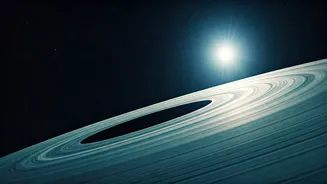
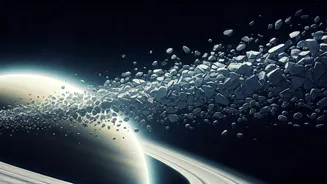
rings is actually water ice. Think of it as a colossal, flat cloud of trillions upon trillions of glistening ice particles, orbiting the planet at incredible speeds. The trace amounts of rocky material, or 'silicates', are what give the rings their subtle, beautiful colours, ranging from bright white to a faint tan or pink. It’s this contamination that helps scientists understand the rings' age and origin. So, instead of a gravel field, picture an endless blizzard of frozen water, frozen in an elegant cosmic dance.
From Dust Grains to City Buses
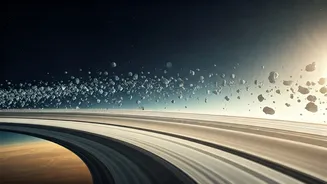
The next mind-blowing fact is the sheer variety in size. When we say 'particles', it's easy to picture something small, like dust or sand. And some of them are! There are countless particles as tiny as a grain of sugar. But the rings also contain chunks of ice the size of pebbles, cricket balls, and even boulders as large as a car or a double-decker bus. The largest pieces can be up to 10 metres across. This incredible range in size is what makes the rings so complex. They aren't a uniform sheet; they are a dynamic system of individual 'moonlets', each following its own orbit, occasionally colliding, and creating the intricate patterns of gaps and waves that we see in high-resolution images sent back by probes like Cassini.
The Ghost of a Shattered Moon
So where did all this ice come from? For a long time, astronomers assumed the rings were as old as Saturn itself, forming from the same primordial cloud of gas and dust. However, data from NASA's Cassini mission, which studied Saturn for 13 years, turned this idea on its head. The rings are pristine, bright, and relatively clean. If they were 4.5 billion years old, they would be dark and dirty, polluted by billions of years of meteorite dust. This suggests the rings are shockingly young—perhaps only 10 million to 100 million years old. They might have been around when dinosaurs still roamed the Earth. The leading theory is that they are the remains of a large, icy moon (or perhaps a passing comet) that strayed too close to Saturn and was ripped apart by the planet's immense gravity. The rings we see today are the beautiful, glittering debris from that cataclysmic event.
A Fleeting Cosmic Masterpiece
Perhaps the most startling reality check of all is that Saturn’s rings are temporary. This glorious cosmic spectacle has an expiration date. Scientists discovered that the ice particles in the rings are constantly being pulled inwards by Saturn’s gravity and magnetic field, creating a phenomenon known as 'ring rain'. This rain is surprisingly heavy, dumping an Olympic-sized swimming pool's worth of water onto Saturn’s upper atmosphere every half hour. At this rate, the entire ring system will drain away and disappear in about 100 million years. While that sounds like a long time to us, in cosmic terms, it’s a blink of an eye. We just happen to be living in a special moment in the solar system's history when Saturn has its magnificent halo. Future intelligent life, millions of years from now, might look at Saturn and see just another plain gas giant, with no clue of the splendour it once possessed.