


The Cosmic Middle Child
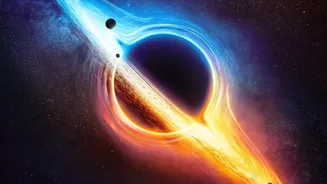
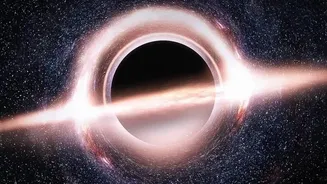
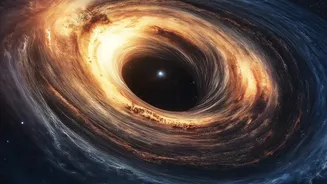
In the universe's grand drama, black holes come in two well-known sizes. There are stellar-mass black holes, weighing up to a few dozen times the mass of our Sun, formed from the collapse of massive stars. At the other end of the spectrum are the supermassive
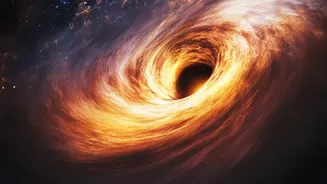
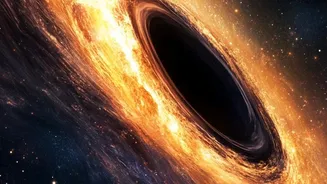
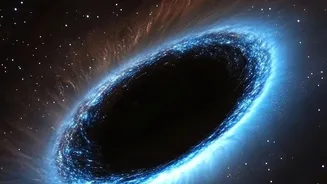
black holes, monsters millions or billions of times our Sun's mass that anchor the centers of nearly every large galaxy, including our own Milky Way. For a long time, there was a puzzling gap between these two extremes. Scientists theorized the existence of intermediate-mass black holes (IMBHs), with masses falling somewhere between 100 and 100,000 times that of the Sun. These cosmic middleweights were frustratingly elusive, too big to be made from a single star's death but not yet galactic behemoths. Finding them was a crucial, but difficult, step in understanding the full story of black hole evolution.
Echoes of a Collision
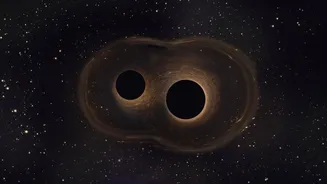
The breakthrough in finding IMBHs came not from seeing them, but from hearing them. When two black holes spiral into each other and merge, they unleash a colossal amount of energy in the form of gravitational waves—ripples in the very fabric of spacetime. First predicted by Albert Einstein, these waves travel across the universe at the speed of light. Incredibly sensitive detectors like the Laser Interferometer Gravitational-Wave Observatory (LIGO) and its international partners, Virgo and KAGRA, can pick up these faint tremors. By analyzing the precise shape and frequency of these waves, scientists can deduce incredible details about their source, including the masses of the merging objects. The detection of an event named GW190521 was a landmark moment; it was the first clear-cut evidence of a merger that produced an IMBH, a black hole weighing about 142 times the mass of the Sun.
Solving the 'Missing Link' Puzzle
The detection of IMBH mergers provides the first concrete evidence for how supermassive black holes might get their start. One of the biggest questions in astrophysics is how supermassive black holes grew so large, so quickly in the early universe. Stellar-mass black holes are too small to grow into giants in the available time simply by feeding on gas and dust. The most compelling theory is a process called hierarchical merging: smaller black holes merge to form larger ones, which then merge again, and so on. IMBHs are the perfect stepping stone in this process. Observing these mergers is like finding a key fossil, proving that the building blocks for supermassive black holes not only exist but are actively being assembled across the cosmos.
Rewriting the Rules of Star Formation
These discoveries are doing more than just filling a gap; they're forcing scientists to rethink fundamental processes. Some of the merging black holes detected, like those in the GW190521 event, had masses that were thought to be impossible to form from a single star's collapse due to a phenomenon called a "pair-instability supernova." This process is believed to blow a star apart, leaving no remnant behind. The fact that black holes exist in this forbidden "mass gap" suggests that our models of stellar evolution are incomplete. The most likely explanation is that these black holes were themselves the products of previous, smaller mergers. This idea of repeated mergers in dense environments like star clusters is now a major focus of research.
The Future of Cosmic Listening
Astrophysicists are just getting started. With each observing run, detectors like LIGO-Virgo-KAGRA are becoming more sensitive, promising to detect more of these distant, cataclysmic events. Future observatories, including the space-based Laser Interferometer Space Antenna (LISA), will be able to detect gravitational waves from even more massive IMBH mergers and at greater distances. These next-generation tools will allow scientists to build a complete census of black holes, tracing their growth from stellar remnants to the galactic giants we see today. Each new detection is another piece of the puzzle, helping us map the hidden, violent, and creative history of the universe.