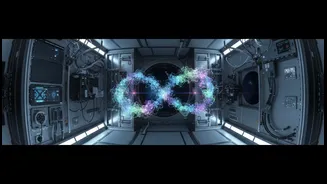







A Quantum Lab in Orbit
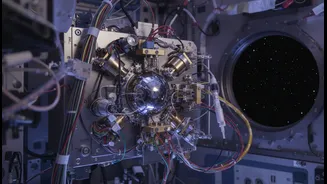
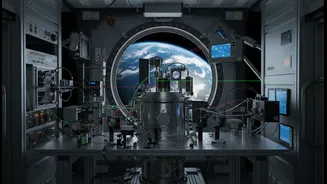
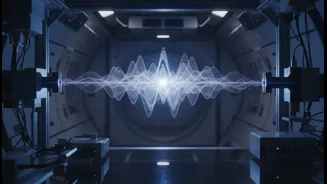
The Cold Atom Lab (CAL) is a sophisticated physics facility designed to study the quantum world in ways impossible on Earth. Controlled remotely by scientists from the ground, its mission is to cool atoms down to temperatures just a fraction of a degree
above absolute zero, which is approximately minus 273 degrees Celsius. Since its installation in 2018, the lab has received several major upgrades, with the latest enhancements installed in 2026. These improvements allow researchers to create larger, more stable clouds of atoms and manipulate them with greater precision than ever before. The lab is a multi-user facility, supporting international teams of scientists who are all eager to explore this bizarre realm of physics.
The Weird World of Ultra-Cold Matter
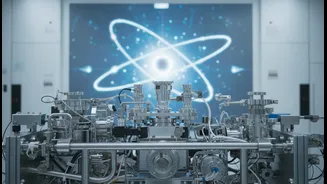
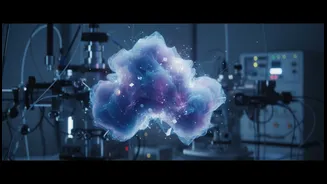
So, what happens when you get matter this cold? The rules of classical physics begin to break down, and the strange laws of quantum mechanics take over. At these temperatures, atoms slow to a crawl and can merge into a fifth state of matter called a Bose-Einstein Condensate (BEC). You can think of atoms in a normal gas as a chaotic mosh pit at a concert, with each person bouncing randomly off others. But in a BEC, it is as if the entire crowd begins to move as one, like a troupe of synchronized swimmers. The individual atoms lose their identity and behave as a single, giant 'super atom' or matter-wave. In this state, particles can display baffling behaviours like being in multiple places at once or passing through each other without colliding.
Why Conduct These Experiments in Space?
The key advantage of the International Space Station is its microgravity environment. On Earth, gravity is a constant disruptive force. When scientists create these delicate BECs in a lab, gravity pulls them apart in fractions of a second. This leaves a very short window for observation. In the near-weightlessness of orbit, however, these quantum states can be maintained for much longer — from five to ten seconds at a time. This extended observation period allows the atom clouds to be cooled to even lower temperatures and lets their quantum wave-like properties expand and evolve in ways that gravity would otherwise mask. It gives scientists a much clearer, longer look into the fundamental nature of matter.
New Upgrades, Deeper Questions
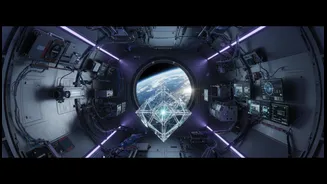
The latest 2026 upgrade has introduced powerful new tools, including a redesigned magnetic trap that acts as an invisible, shape-shifting container for the atom clouds. Scientists can now not only hold the BECs but actively sculpt them, squeezing them into different shapes to investigate how their quantum properties change. This capability is raising new questions. How do these quantum gases behave when their geometry is altered? Do their interactions reveal subtle physical laws that our current theories don't predict? Every new answer seems to unlock an even more profound question, pushing scientists beyond confirming old theories and into a mode of pure discovery.
The Promise of Precision Sensing
This fundamental research has incredibly practical implications. The extreme sensitivity of these cold atoms to their surroundings makes them perfect candidates for next-generation quantum sensors. Because the atoms in a BEC act as a single, coherent entity, they can detect minuscule changes in gravity, magnetic fields, and motion. This could lead to a technological revolution dubbed 'Quantum 2.0'. Applications could include navigation systems for deep space that don't rely on GPS, instruments that can map underground water reserves or monitor melting ice sheets on Earth with unprecedented accuracy, and ultra-precise atomic clocks that are crucial for modern communications. By studying the universe's coldest matter, we are paving the way for some of the hottest new technologies on Earth and beyond.