


The Universe’s Greatest Mystery
For decades, physicists have been grappling with a monumental puzzle: the universe is not only expanding, but it's doing so at an ever-increasing speed. The force driving this acceleration is called dark energy. This isn't just a minor detail; it's the dominant
component of our cosmos, accounting for roughly 68% of everything. Despite its prevalence, we know almost nothing about it. Is it a constant energy of empty space, as Einstein once proposed, or is it something else entirely, something that might change over time? Answering this will determine the ultimate fate of our universe, whether it ends in a 'Big Rip' or a 'Big Crunch'. To get those answers, we need to map the expansion of the universe across its entire history.
Introducing the CHIME Telescope
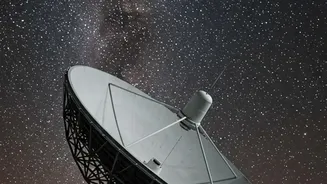
Enter the Canadian Hydrogen Intensity Mapping Experiment, or CHIME. Located in British Columbia, it doesn't look like a typical telescope. Instead of a large dish, it consists of four massive, stationary half-pipe-shaped reflectors. With no moving parts, CHIME relies on the Earth's rotation to scan the entire northern sky every single day. This unique design makes it exceptionally good at mapping vast swathes of the cosmos quickly. While famously known for detecting mysterious Fast Radio Bursts (FRBs), CHIME's primary mission was always to chart the history of the universe's expansion to shed light on dark energy.
Listening for an Ancient 'Cosmic Ruler'
To measure cosmic expansion, astronomers need a 'standard ruler'—an object of a known size that they can measure at different distances. For this, they use something called Baryon Acoustic Oscillations (BAO). Think of them as fossilised sound waves from the very early universe. Shortly after the Big Bang, the universe was a hot, dense soup of particles and radiation. Ripples of pressure, like sound waves from a stone dropped in a pond, spread through this plasma. When the universe cooled enough for atoms to form, these waves froze in place, leaving a faint imprint on the distribution of matter, creating a characteristic scale or 'ruler' that scientists can still detect today. By measuring how large this ruler appears at different points in cosmic history, astronomers can track the expansion of the universe with incredible precision.
A Breakthrough Signal
Recently, the CHIME collaboration announced a major breakthrough: for the first time, they detected the signature of this ancient hydrogen using only their own data. Previously, confirming these faint signals required cross-referencing with expensive and time-consuming surveys from other optical telescopes. This new result, based on data from 2019, proves that CHIME’s method of 'intensity mapping' works independently. It measures the combined radio glow of neutral hydrogen gas from a period when the universe was about five billion years old. This is a critical era, as it's when dark energy began to dominate over gravity, starting the universe's accelerated expansion.
A New Path for Cosmology
This achievement isn't the final answer to the dark energy puzzle, but it is a pivotal 'proof of concept'. It demonstrates a faster, cheaper, and more comprehensive way to map the universe. Unlike traditional galaxy surveys that focus on small, bright patches of the sky, CHIME's intensity mapping can create a three-dimensional map of matter over enormous volumes of space. It can trace the faint radio emission from hydrogen, the most common element in the cosmos, revealing the large-scale structure of the universe. This new, independent method allows scientists to test existing theories about dark energy and galaxy formation with a fresh set of eyes.