






The Universe in a Hard Drive
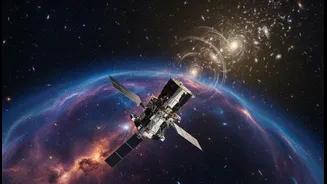
Modern astronomy is a science of big data. Missions like the Hubble Space Telescope and the Kepler space observatory have gathered colossal amounts of information over their lifetimes, far more than scientists can analyze at once. This data is meticulously
stored in digital archives, creating a treasure trove of cosmic information. Initially, scientists search this data for specific phenomena they expect to find. However, the initial pass often misses faint signals or unusual patterns. Data reprocessing is the act of returning to these vast archives—sometimes years or even decades later—and applying new analytical methods, more powerful computer algorithms, or updated theoretical models to sift through the noise and find what was previously missed.
Finding Planets Between the Lines
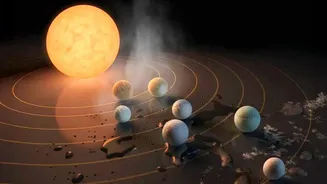
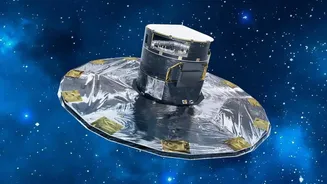
The hunt for exoplanets provides some of the most dramatic examples of this process. NASA's Kepler mission, which ended in 2018, generated a staggering amount of data by staring at a patch of stars, looking for the tell-tale dimming caused by a planet passing in front of its star. While it discovered thousands of planets during its operation, many more were found long after the mission ended. In 2020, scientists announced the discovery of Kepler-1649c, an Earth-sized planet in its star's habitable zone, found by developing new algorithms to sort through signals that had previously been misidentified as false positives. Similarly, a new catalog of Kepler data released in 2_023 used refined methods to confirm a rare seven-planet system around a star called Kepler-385, revealing new details about planets that were first flagged years earlier.
New Tricks for Old Data
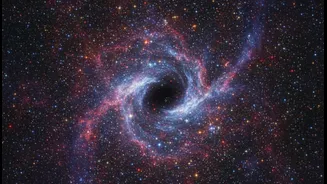
It's not just about better software; it's about new ways of looking. Recently, a team of astronomers located the first stellar-mass black hole in the massive Omega Centauri star cluster by combining over 20 years of archival Hubble data with recent observations from the James Webb Space Telescope. Instead of looking for the usual tell-tale signs, they used a technique called astrometry to measure the tiny, precise movements of a star being tugged by an invisible companion. This innovative approach, applied to old data, solved a long-standing puzzle about where the cluster's black holes were hiding. This demonstrates how new techniques can unlock secrets buried in existing datasets, turning archives into renewable resources for discovery.
The Rise of the Machines
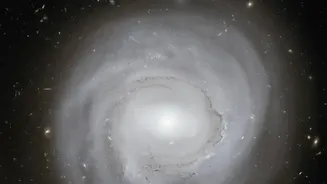
The sheer volume of astronomical data now makes it impossible for humans to inspect manually. This is where artificial intelligence is changing the game. In early 2026, researchers used an AI system to scan millions of image fragments from the Hubble archive in just a few days. The AI flagged over a thousand cosmic anomalies—things like rare galaxies and gravitational lenses—that had been overlooked for decades. More than 800 of these had no previous mention in scientific literature, opening up entirely new avenues for research. This AI-driven approach allows scientists to efficiently mine massive datasets, concentrating their expert attention on the most promising and unusual signals that the machine finds. This synergy between human expertise and machine processing is rapidly accelerating the pace of discovery.