




The Unbreakable Law of Delay
The single greatest challenge of communicating with Mars isn't technology; it's physics. Radio waves travel at the speed of light, the universe's ultimate speed limit. Because Earth and Mars are constantly moving in their orbits, the distance between
them varies wildly. At their closest, a signal takes about three to four minutes to travel one way. At their farthest, that delay stretches to about 22 minutes. This means a simple conversation, with a question and a response, involves a round-trip delay of anywhere from six to 44 minutes. This fundamental constraint shapes every aspect of mission design, forcing a radical difference in how we 'talk' to robots versus how we will need to support humans.
How We Talk to Robots
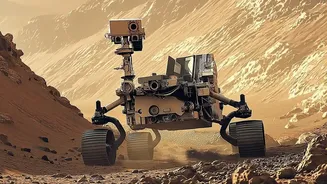
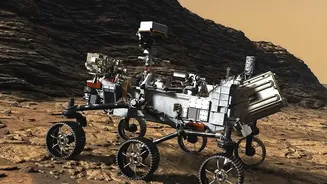
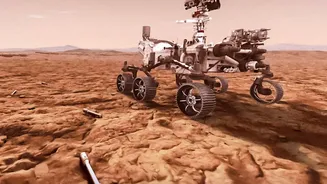
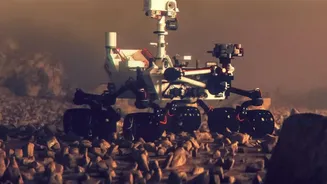
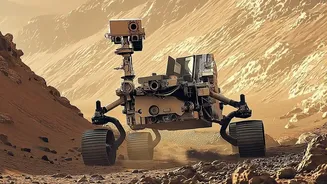
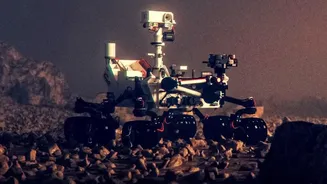
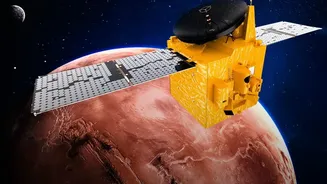
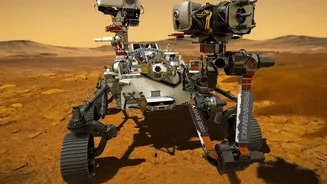
Current robotic explorers like the Perseverance and Curiosity rovers don't engage in real-time chats. Instead, mission controllers on Earth carefully package a full day's worth of commands and beam them to Mars. The rover then executes these instructions autonomously. For sending back large volumes of data, such as high-resolution images, rovers use a clever relay system. They send their data via a UHF link to an orbiter, like the Mars Reconnaissance Orbiter (MRO), passing overhead. The orbiter, with its larger antenna and more powerful transmitter, then relays that data back to the massive dishes of the Deep Space Network (DSN) on Earth. This 'store-and-forward' method is efficient for science but slow. While data rates between the rover and orbiter can reach up to 2 megabits per second (Mbps), the overall process is methodical and built around patience.
The Human Equation
Humans on Mars will have vastly different and more urgent communication needs. While rovers are tough and can wait for instructions, astronauts need a robust, high-bandwidth connection for safety, science, and sanity. Critical mission support, such as consulting with flight surgeons during a medical emergency, requires transmitting high-definition video and biometric data. Scientists on Earth will need access to large data files from experiments without waiting days. The data demands for a human crew are expected to be many times greater than what robotic missions currently handle, requiring a leap from kilobits or megabits per second to hundreds of megabits, or even gigabits. This is the difference between sending a daily email and running a 24/7 video conference.
More Than Just Data
Beyond the technical requirements, the communication delay has profound psychological effects. Astronauts on the International Space Station enjoy near-instant communication with Earth, a vital link that mitigates the intense isolation of space. For a Mars crew, that real-time link will be gone. A 40-minute lag turns a conversation into an exchange of recorded messages, straining connections with mission control and loved ones back home. Studies in analog environments, which simulate Mars mission conditions, show that such delays increase stress, frustration, and the potential for miscommunication. A crew that cannot effectively communicate in a crisis is a crew at risk, making psychological self-sufficiency and autonomous decision-making critical skills.
Building a Better Bridge to Mars
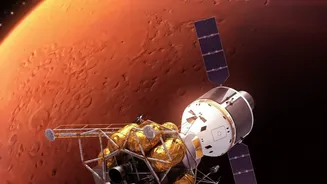
To meet the demands of human exploration, space agencies are developing next-generation communication technologies. The most promising is laser, or optical, communication. Instead of radio waves, this method uses infrared lasers to encode and transmit data. Laser communication systems can offer data rates 10 to 100 times higher than current radio systems, making high-definition video from Mars a reality. NASA has already been testing this with its Deep Space Optical Communications (DSOC) experiment. The ultimate goal is to create an interplanetary network, with dedicated communication relay satellites in orbit around Mars, that can provide a continuous, high-speed data pipeline back to Earth, ensuring our explorers are never truly alone.