








A Universe of Overwhelming Data
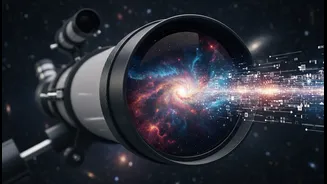
Imagine trying to drink from a firehose. That’s the challenge facing modern astronomers. Projects like the upcoming Vera C. Rubin Observatory will generate petabytes of data, creating a digital map of the sky so vast that no single team of scientists
could ever hope to analyse it all. For decades, the solution has been automation and artificial intelligence, with algorithms trained to sort, classify, and flag objects of interest. These systems are incredibly efficient at finding what they are programmed to find, such as typical spiral or elliptical galaxies. However, their great strength is also their great weakness: they often miss the truly strange, the unexpected, and the anomalies that don't fit neatly into pre-defined categories. This is where the human eye, with its unparalleled ability for pattern recognition, still holds a distinct advantage.
The Unique Power of the Human Brain
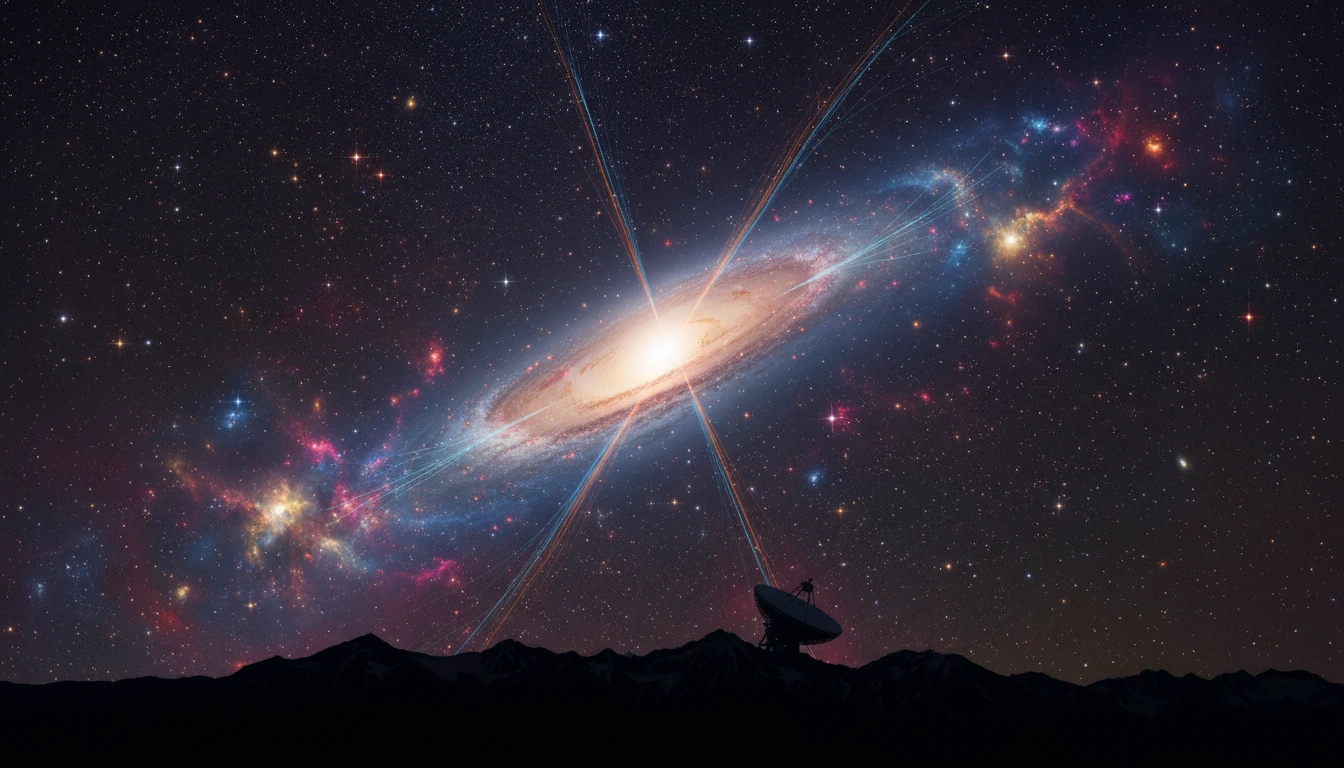
The human brain is an extraordinary pattern-recognition machine. We can spot a familiar face in a crowd, recognise a friend's voice in a noisy room, and identify subtle oddities that a computer might overlook. In astronomy, this translates to spotting weirdly shaped galaxies, unusual light fluctuations, or faint structures that an algorithm, trained on millions of 'normal' examples, would dismiss as noise. A recent discovery by an Indian citizen science network, RAD@home, perfectly illustrates this. A participant identified a unique 'bow-and-arrow' shaped galaxy that automated systems had previously miscatalogued as ordinary. This ability to spot something fundamentally different is the core value proposition of citizen science in the age of big data. It’s not just about adding more hands; it’s about adding a different, more intuitive kind of intelligence.
Sikkim's Quiet Scientific Ascent
While there may not be a single, formal programme named 'Sikkim Citizen Science Astronomy', the state is fostering an environment ripe for such an initiative. The Sikkim State Council of Science & Technology has been actively working to promote scientific awareness and develop infrastructure, such as the Sikkim Science Centre at Marchak which is slated to get a planetarium. Initiatives like the nationwide INSPIRE programme are also in place to cultivate scientific talent from a young age. By combining this growing local infrastructure with established Indian citizen science platforms like RAD@home or projects from the Pune Knowledge Cluster, there is immense potential. A Sikkim-based effort could focus on training a dedicated group of students and enthusiasts, leveraging the state's focus on education and technology to create a hub for high-quality data analysis.
Substance Over Sensationalism
The biggest challenge for any citizen science project is managing expectations and avoiding the 'discovery hype'. Many volunteers are drawn in by the exciting prospect of finding a new planet or a black hole. While these discoveries do happen, the vast majority of work is less glamorous but equally vital. It involves the meticulous task of classifying thousands of images or flagging subtle features—work that builds the foundational datasets upon which major discoveries are made. A successful Sikkim-based programme would need to focus on the value of this sustained contribution, framing it not as a lottery for a 'Eureka!' moment but as a serious, collaborative research effort. The goal isn't just to find something new, but to create a reliable stream of well-analysed data that professional astronomers can trust. This approach trades the fleeting excitement of hype for the long-term satisfaction of making a genuine contribution to our understanding of the cosmos.