
Decoding the Language of Light
One of the most powerful tools in an astronomer's toolkit is spectroscopy. When a planet passes in front of its star, a tiny fraction of the starlight filters through the planet's atmosphere. Telescopes like the James Webb Space Telescope (JWST) can capture
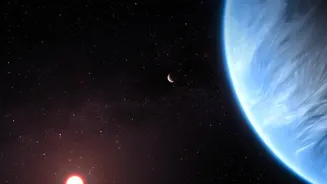
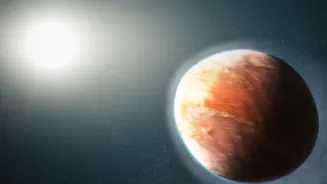
this light and split it into a spectrum, like a rainbow. Different molecules absorb light at specific wavelengths, leaving behind a unique 'barcode'. By analysing this barcode, scientists can identify gases like water vapour, methane, and carbon dioxide in an exoplanet's atmosphere. The presence or absence of certain chemicals, such as ammonia dissolving in water, can even suggest a planet-wide ocean. This method has been used to study potential 'Hycean' worlds—hypothetical planets with deep oceans and hydrogen-rich atmospheres—like K2-18b.
The Telltale Wobble of Gravity
For icy moons within our own solar system, like Jupiter's Europa or Saturn's Enceladus, gravity provides profound clues. As a spacecraft like NASA's Galileo or Europa Clipper orbits or flies by, it experiences tiny gravitational tugs from the moon. By precisely measuring these variations, scientists can map the moon's internal structure. A global, subsurface ocean of liquid water would cause a specific and detectable gravitational signature. Instruments like magnetometers also play a key role. A salty, liquid ocean would interact with the parent planet's magnetic field, creating its own induced magnetic field. Detecting this secondary field is a primary goal of the Europa Clipper mission, as it would provide strong evidence of a hidden ocean's existence, depth, and even its salinity.
Peering Beneath the Ice
Finding a hidden ocean is one thing; characterising the ice shell above it is another. For this, astronomers turn to ice-penetrating radar. This technique, which has been used to find subglacial lakes in Antarctica, is a cornerstone of the Europa Clipper mission. The radar instrument will send radio waves through Europa's icy crust and listen for reflections from boundaries below. These echoes can reveal the thickness of the ice shell and, excitingly, may even detect pockets of liquid water or 'lakes' embedded within it. This data, combined with images from high-resolution cameras and thermal instruments that look for warm spots or recent eruptions, helps build a detailed map of the moon's surface and subsurface.
Catching a Plume
Some icy moons, like Enceladus and potentially Europa, are not entirely sealed. They are known to vent giant plumes of water vapour and ice particles into space from their subsurface oceans. These geysers offer a direct sample of what lies beneath without ever needing to drill through the ice. Spacecraft can fly through these plumes and 'taste' their composition using instruments called mass spectrometers. NASA's Cassini mission did exactly this at Enceladus, discovering water, salts, and organic molecules. The James Webb Space Telescope and the upcoming Europa Clipper mission will also search for and analyse plumes, looking for chemical ingredients that could point towards a habitable environment. While not a direct search for life, finding a complex chemical soup could indicate that the ocean below has the necessary components to support it.