



Starting in the 'Goldilocks Zone'
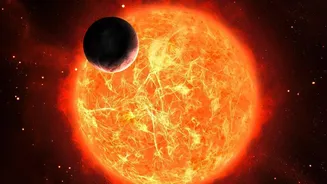
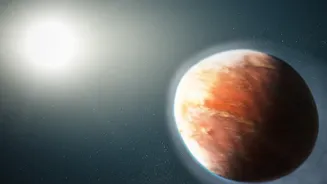
The first step in finding a watery world is to look in the right place. Scientists begin by identifying planets within their star's 'habitable zone', often called the 'Goldilocks zone'. This is the orbital region where the temperature is not too hot and
not too cold, but just right for liquid water to potentially exist on a planet's surface. A planet too close to its star would be scorching, causing any water to boil away. One too far would be a frozen wasteland. The size and heat of the star determine where this zone lies; cooler, dimmer stars have habitable zones much closer in than hotter, brighter stars. Finding a planet in this zone is the crucial first filter, providing a list of promising candidates for further investigation.
Reading the Air for Clues
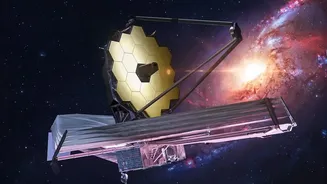
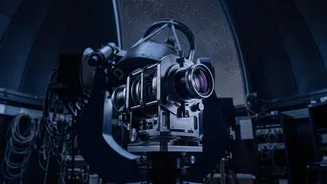
Once a candidate is found, telescopes like the James Webb Space Telescope (JWST) perform a kind of long-distance atmospheric analysis. Using a technique called transmission spectroscopy, scientists examine the light from the planet's host star as it filters through the exoplanet's atmosphere during a transit. Different molecules in the atmosphere absorb light at specific wavelengths, leaving a unique chemical 'fingerprint'. The detection of water vapour in the atmosphere is a massive clue. While it doesn't guarantee an ocean—the water could just be atmospheric humidity—it's a critical piece of evidence suggesting the planet has the necessary ingredients for surface water.
A Telltale Lack of Carbon Dioxide
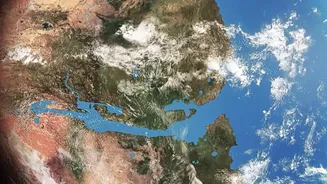
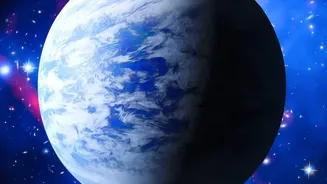
A new and promising method involves comparing the carbon dioxide (CO2) levels of planets within the same star system. Researchers have theorised that if a rocky planet in the habitable zone has significantly less CO2 in its atmosphere than its neighbours, it could be a strong indicator of a surface ocean. The logic is that large bodies of liquid water would absorb vast amounts of atmospheric carbon dioxide, dissolving it into the ocean. This 'habitability signature' provides a powerful, practical method for identifying planets with liquid water that can be used by current observatories like the JWST, potentially accelerating the discovery of habitable worlds.
Weighing the Planet
Just like you can tell the difference between a block of wood and a block of iron of the same size by their weight, scientists can learn about a planet's composition by determining its density. By measuring a planet's size via the transit method (how much light it blocks) and its mass via the radial velocity method (how much it makes its star 'wobble'), astronomers can calculate its overall density. A low-density planet is likely a gas giant, while a high-density one is probably rocky. A planet with a density suggesting it's rocky but slightly less dense than Earth could indicate a composition rich in water, either as surface oceans or integrated into its minerals. This data helps build a more complete picture of the planet's likely makeup.
Hunting for a Distant Glint
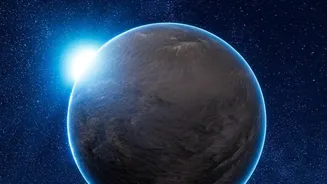
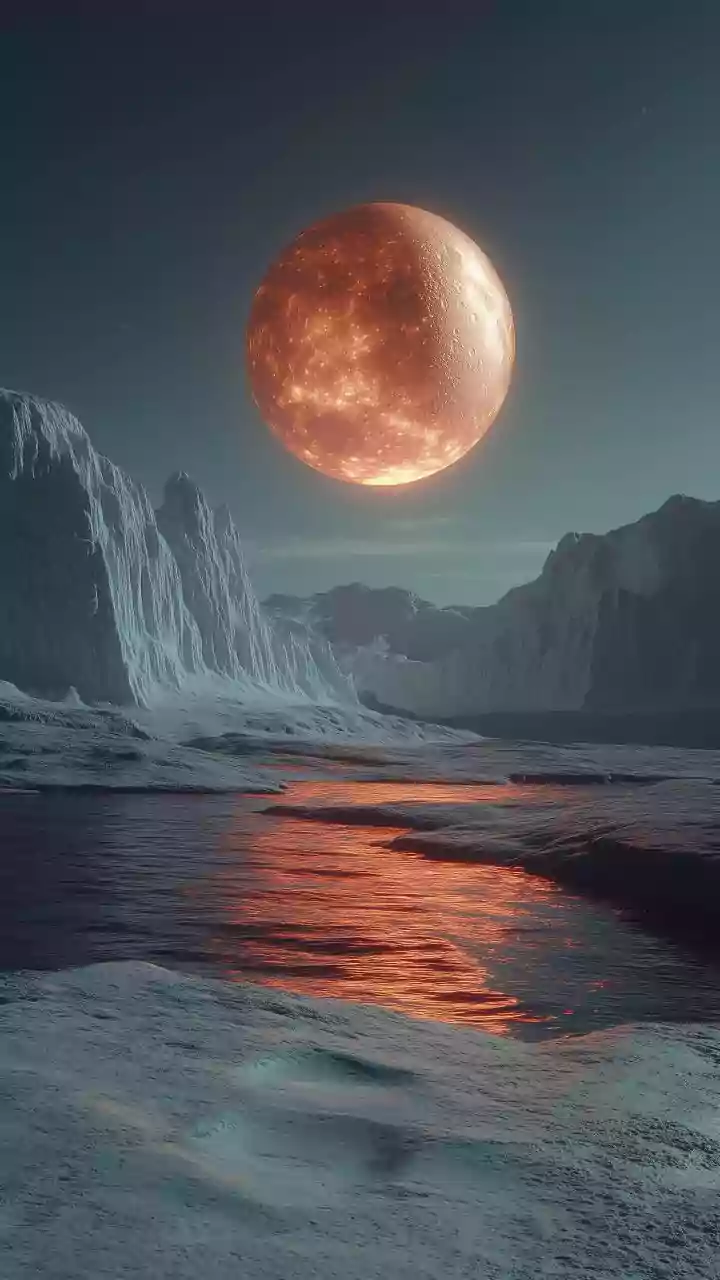
One of the most direct, though technically challenging, methods is the search for 'ocean glint'. This involves looking for the specular reflection—the mirror-like flash of starlight bouncing off a smooth liquid surface. As an exoplanet rotates and orbits its star, its brightness and the polarisation of its reflected light will change. Scientists can create models that predict how a planet with vast oceans would look at different phases. Oceans would appear dark from most angles but would create a distinct bright, polarised glint when viewed at a crescent phase. Detecting this faint signal is incredibly difficult and likely requires future observatories, but it would provide some of the most unambiguous evidence for a liquid sea.