



Earth's Twisted Twin
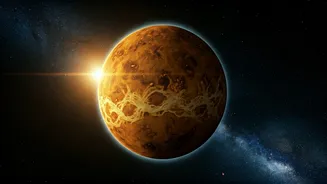
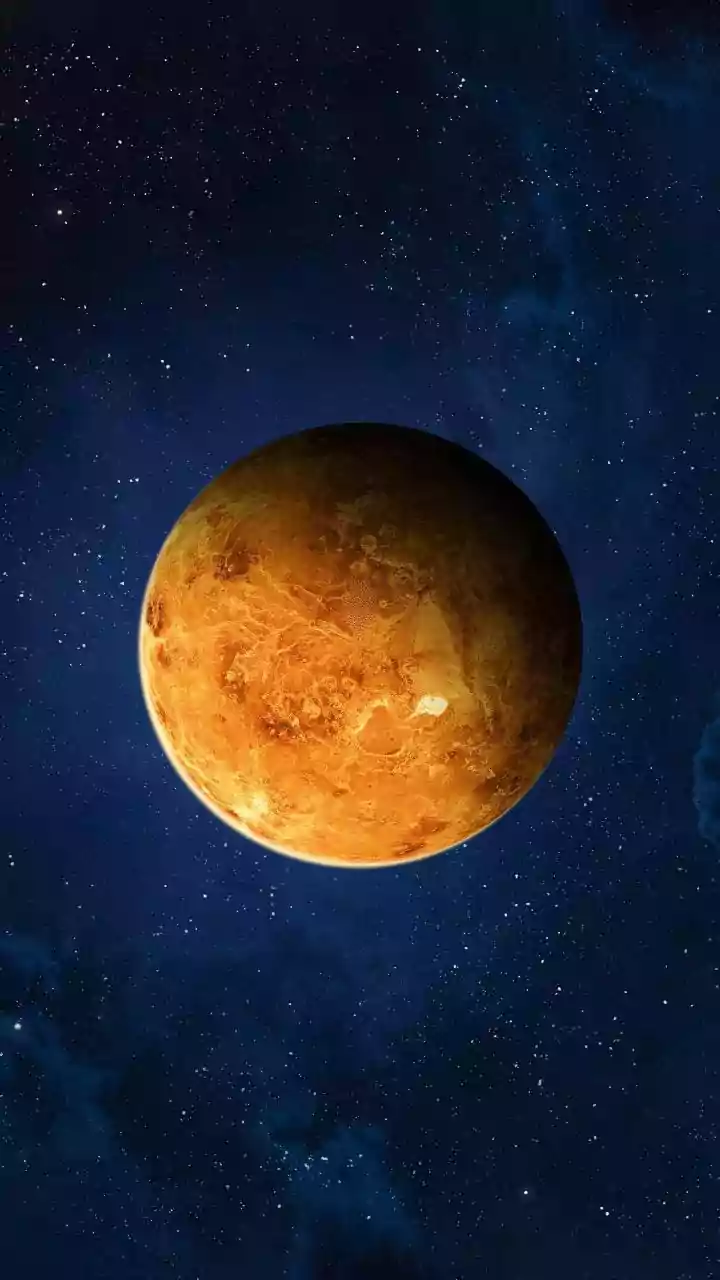
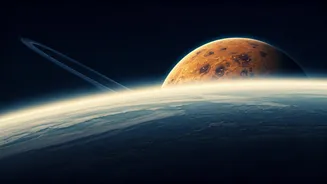
In many ways, Venus is Earth's sister planet. It’s similar in size, mass, and composition, and it’s our closest planetary neighbour. But the similarities end there. Venus is a hellscape wrapped in a thick, toxic atmosphere of carbon dioxide, with surface
temperatures hot enough to melt lead. And perhaps its most peculiar feature, the one that continues to puzzle astronomers, is its staggeringly slow and backward rotation. While Earth completes a spin in 24 hours, giving us our familiar cycle of day and night, Venus takes its sweet, sweet time.
Just How Slow Is It?
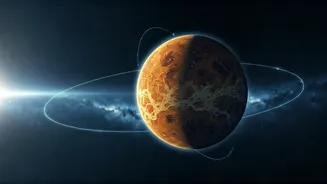
To call Venus's rotation 'slow' is an understatement. A single day on Venus—the time it takes to complete one full rotation on its axis—is approximately 243 Earth days. Now, consider this: it only takes Venus about 225 Earth days to complete one full orbit around the Sun. This means a Venusian day is longer than a Venusian year. Imagine celebrating your birthday before the sun has even set on the day you were born! Because of this odd relationship between its spin and orbit, a 'solar day' on Venus (the time from one sunrise to the next) is shorter, but still an incredibly long 117 Earth days. No matter how you measure it, Venus is the slowest-spinning planet in our solar system by a huge margin.
Spinning the Wrong Way
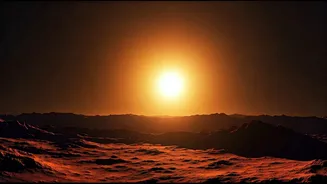
Adding to the weirdness is the direction of its spin. Nearly every planet in our solar system, including Earth, rotates on its axis in the same direction they orbit the Sun: counter-clockwise, or 'prograde.' Venus is the odd one out. It spins clockwise, a phenomenon known as retrograde rotation. If you could stand on the surface of Venus (and survive), you would see the Sun rise in the west and set in the east. Only Uranus, which is tilted on its side, shares this kind of rotational peculiarity. This backward spin is a major clue for scientists trying to piece together the planet’s violent and mysterious past.
Theory 1: A Catastrophic Collision
So, what could have caused this? One of the leading theories points to a cataclysmic event deep in Venus's history. According to the 'Giant Impact Hypothesis,' a massive, planet-sized object may have collided with a young Venus billions of years ago. Such a powerful impact could have done two things. First, it could have drastically slowed the planet's original rotation. Second, depending on the angle and force of the collision, it could have been powerful enough to completely reverse its spin. This idea suggests that Venus's current state is the result of a cosmic billiard-shot that fundamentally altered its planetary mechanics forever.
Theory 2: The Weight of the Atmosphere
An alternative, and equally compelling, theory suggests the culprit wasn’t a single impact but a long, drawn-out process involving Venus’s own atmosphere. The atmosphere of Venus is incredibly dense—about 90 times thicker than Earth's. This creates immense surface pressure and powerful thermal tides, essentially atmospheric waves driven by the Sun's heat. Over billions of years, the gravitational pull of the Sun on this bulky atmosphere could have created enough friction and drag to gradually slow Venus's original, faster prograde rotation to a halt, and then slowly cause it to start spinning in the opposite, retrograde direction. In this model, Venus's own runaway greenhouse effect is responsible for its bizarre spin.
A Never-Ending Sunset
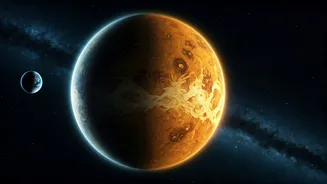
The consequences of this slow rotation are profound. With a day-night cycle lasting months, the side of Venus facing the Sun bakes for an extended period, while the night side is plunged into a very long darkness. You might expect the night side to freeze, but the planet’s thick blanket of an atmosphere is remarkably efficient at trapping and circulating heat. Winds whip around the planet at hundreds of kilometres per hour, distributing the heat so evenly that there’s very little temperature difference between the day side, the night side, and the poles. It’s always scorching hot, everywhere. This combination of a slow spin and a super-thick atmosphere makes Venus one of the most inhospitable places imaginable.