



The universe is filled with mysteries, from the first moments after the Big Bang to the cosmic nurseries where stars and planets are born. NASA's SPHEREx mission, now scanning the cosmos, is a powerful new tool designed to answer these big questions.
A Cosmic Map Like No Other
Imagine trying to understand a country's history using only a few city maps. You would miss the bigger picture. This is the challenge astronomers face. Telescopes like Hubble and James Webb provide stunningly deep views of small patches of the sky, but SPHEREx does something different. Launched in March 2025, its job is to create a map of the entire sky, not just once, but four times over its two-year primary mission. By scanning in near-infrared light, which is invisible to the human eye, it can peer through cosmic dust to see what lies beyond. The mission has already completed its first all-sky map, a major milestone celebrated in late 2025. This isn't just one map, but 102 different maps, each captured in a unique wavelength of infrared light. This unprecedented approach gives scientists a comprehensive, color-coded guide to the cosmos.
Unlocking Three Great Cosmic Mysteries
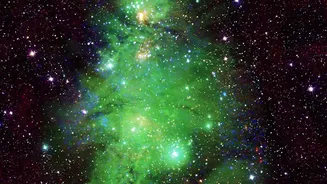
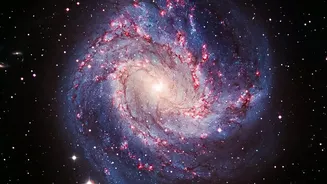
The Spectro-Photometer for the History of the Universe, Epoch of Reionization, and Ices Explorer—or SPHEREx for short—was designed with three major scientific goals in mind. First, it's hunting for clues about the universe's explosive start. By mapping the 3D distribution of hundreds of millions of galaxies, scientists can study the after-effects of 'inflation', the process that caused the universe to expand at an almost unimaginable rate just a fraction of a second after the Big Bang. Second, SPHEREx is tracing the history of galaxy formation, measuring the faint, collective glow from countless galaxies to understand how they've evolved over billions of years. And third, it's searching our own Milky Way for the building blocks of life, specifically water and organic molecules frozen as ice in the vast clouds where new stars and planets form. By early 2026, the mission had already mapped vast regions of this interstellar ice.
The Technology Behind the Vision
SPHEREx achieves its ambitious goals with a surprisingly simple and elegant design. It carries a 20-centimetre telescope that, unlike its more famous cousins, has a very wide field of view. This allows it to survey huge swaths of the sky quickly, capturing about 3,600 images every day. The key technology is its spectrophotometer, which breaks down the light from every object into its component wavelengths, essentially taking a 'fingerprint' of hundreds of millions of objects. To detect faint infrared signals from the distant universe, the telescope must be incredibly cold, operating at temperatures around -223 degrees Celsius. This is achieved with a clever cooling system and multiple shields that protect it from the heat of the Sun and Earth. The entire operation is a masterclass in efficiency, designed to deliver a massive return on scientific investment.
Worlds Between Stars and Planets
While SPHEREx looks at galaxies far away, it also provides a fresh perspective on objects closer to home that blur the lines between stars and planets. In late 2026, the mission released new findings on brown dwarfs, often called 'failed stars'. These celestial bodies are more massive than planets like Jupiter but not quite massive enough to ignite into a star. By analyzing them in infrared light, SPHEREx has shown that these dim worlds have chemically rich atmospheres, similar to the gas giants in our own solar system. By studying dozens of these objects, the mission is helping to fill a major gap in our understanding of how both stars and planets evolve. It has also proven adept at studying interstellar visitors, like the comet 3I/ATLAS, providing valuable data on objects from beyond our solar system.