






A Cosmic Wobble Confirms Einstein's Prediction
More than 100 years ago, Albert Einstein's theory of general relativity predicted a bizarre and wonderful phenomenon: that a massive, rotating object could literally drag the fabric of spacetime around with it. This effect, known as frame-dragging or the Lense-Thirring
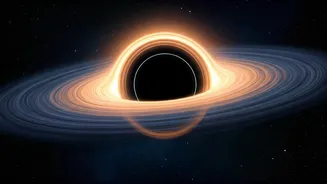
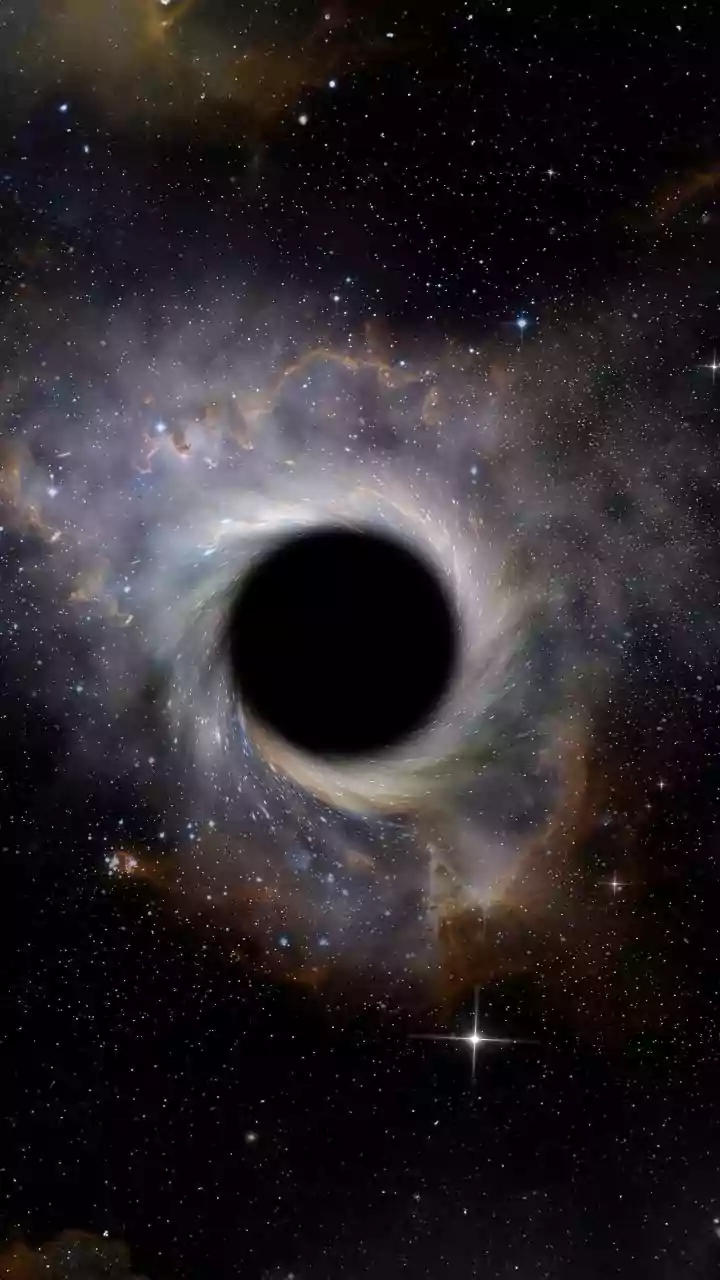
effect, is so subtle that it's incredibly difficult to detect. But astronomers have recently captured the most compelling evidence of it yet, by watching a supermassive black hole devour a star. In an event dubbed AT2020afhd, a star wandered too close to a black hole and was torn apart by its immense gravity, a process called a tidal disruption event. The stellar remains formed a glowing, superheated platter of gas called an accretion disk, which began spiraling into the black hole, while also launching powerful jets of material. By observing this violent cosmic meal, scientists noticed something extraordinary in the X-ray and radio signals: the entire system was wobbling, and this wobble repeated like clockwork every 20 days.
What Exactly Is a 'Spacetime Twist'?
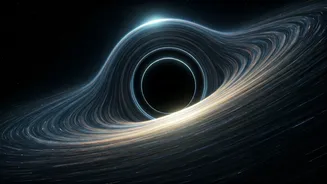
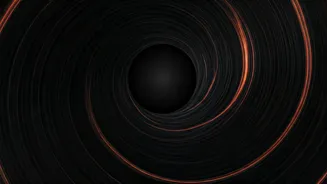
Think of a bowling ball spinning in a giant tub of honey. As it spins, it doesn't just sit there; it drags the honey closest to it into a swirl. A spinning black hole does something similar, but instead of honey, it drags the very fabric of reality—spacetime itself. This is frame-dragging. Any matter near the black hole is caught in this spacetime vortex. If the matter, like an accretion disk, is orbiting the black hole at an angle relative to the black hole's spin, this dragging force will cause the disk's orbit to wobble, or precess, much like a spinning top that's slightly off-kilter. This precession is precisely what astronomers detected. The spinning black hole's axis was misaligned with the plane of the shredded star's debris, and the resulting spacetime drag forced the inner part of the accretion disk to wobble. This wobble, in turn, caused the jets of material shooting out from the black hole's poles to change their direction periodically, creating a repeating signal that telescopes on Earth could detect.
How Astronomers Became Cosmic Detectives
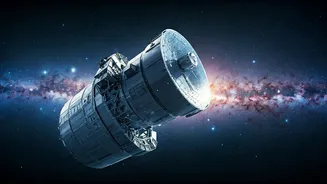
Observing this effect required a coordinated effort using multiple powerful telescopes. Scientists used NASA's Neil Gehrels Swift Observatory to monitor X-rays coming from the hot inner region of the accretion disk. Simultaneously, the Karl G. Jansky Very Large Array (VLA) tracked radio waves emitted by the powerful jets. They found that the rhythmic changes in both the X-ray and radio signals were synchronized, implying the disk and the jet were wobbling in unison with that distinct 20-day period. The team, led by researchers at the Chinese Academy of Sciences, modeled these signals and concluded that Lense-Thirring precession was the most compelling explanation for the coordinated wobble. This marks the first time this frame-dragging effect has been so clearly observed during a tidal disruption event, providing a natural laboratory to test the limits of general relativity.
Why This 20-Day Beat Matters
This discovery is more than just another confirmation that Einstein was right. The regular, 20-day cycle provides a new tool for understanding the most extreme objects in the universe. By measuring the period of the wobble, scientists can learn about the properties of the black hole itself, such as how fast it's spinning. It also offers unprecedented insight into the physics of accretion disks and how black holes launch their spectacular jets. The fact that this particular black hole system, AT2020afhd, is misaligned is also a puzzle. In systems like our own solar system, planets orbit on roughly the same plane as the Sun's rotation. In some black hole systems, like MAXI J1820+070, a significant misalignment has been observed, possibly caused by a 'kick' the black hole received during the supernova explosion that formed it. The wobble in AT2020afhd gives scientists a new way to probe the history and mechanics of these uniquely tilted systems.