





First, What Is Space Weather?
Think of space weather as the Sun’s temper tantrums. Instead of just bathing us in steady light and heat, our star occasionally flings massive amounts of energy and magnetised particles into space. These events, known as solar flares and Coronal Mass
Ejections (CMEs), travel across the solar system at incredible speeds.. When they collide with Earth, they can have serious consequences for our technology-driven society. A severe space weather event can disrupt satellite operations, damage power grids, interfere with GPS and navigation services, and interrupt communications.. Essentially, the invisible shield of Earth's magnetic field, which normally protects us, can be compressed and disturbed, exposing our critical infrastructure to harsh conditions in space.
India’s Eye on the Sun: Aditya-L1
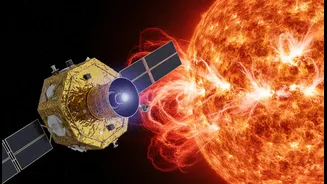
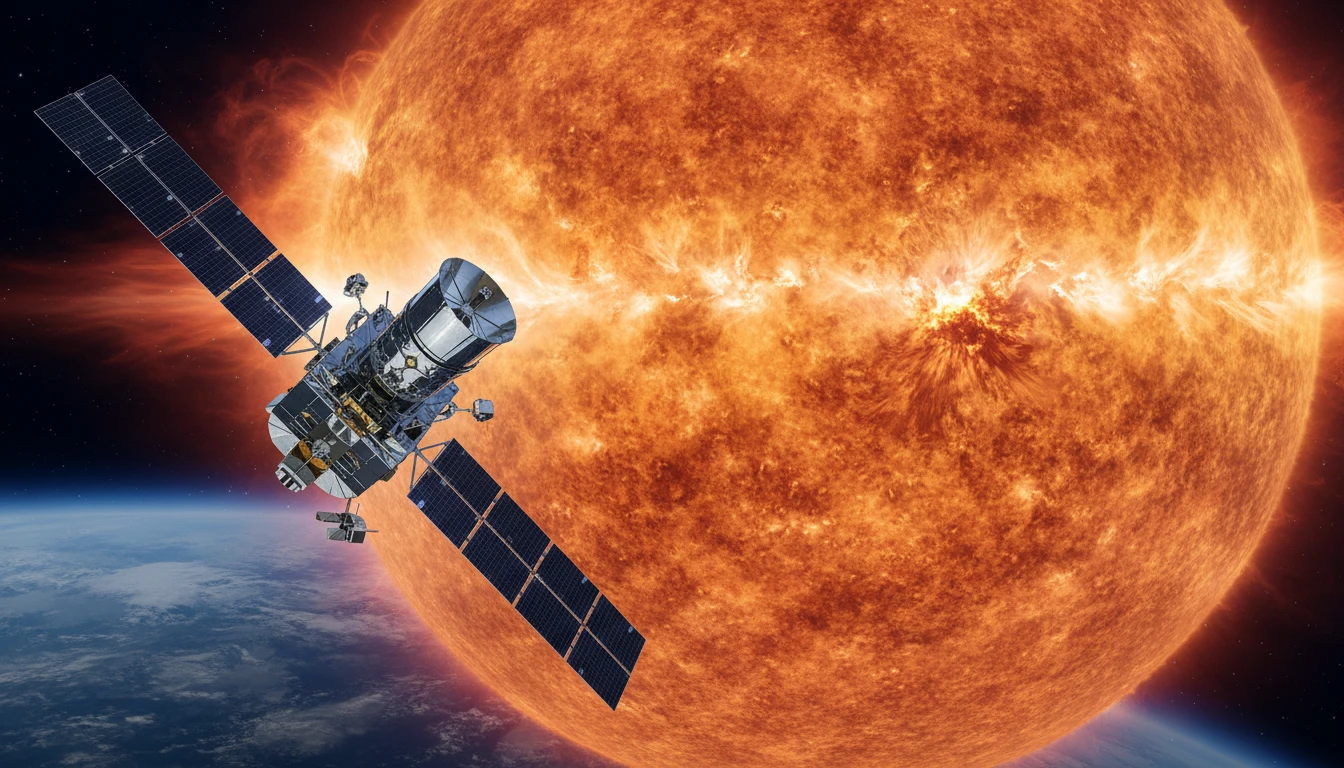
Enter ISRO's Aditya-L1, India’s first dedicated space-based solar observatory. Launched in September 2023, this sophisticated spacecraft is not just orbiting Earth; it is stationed at a unique spot 1.5 million kilometres away, called the Lagrange Point 1 (L1).. From this vantage point, Aditya-L1 gets a continuous, uninterrupted view of the Sun, 24/7.. It is equipped with seven advanced instruments designed to observe the Sun's outer layers—the photosphere, chromosphere, and corona—and to measure the solar wind and magnetic fields as they race towards Earth.. This allows Aditya-L1 to act as an early warning system, giving scientists crucial data to anticipate and analyse solar storms before they arrive. In fact, it has already proven its worth by providing breakthrough insights into a powerful solar storm that impacted Earth.
More Than One Piece of the Puzzle
While Aditya-L1 is the star of the show, ISRO's space weather strategy is multifaceted. India’s indigenous navigation system, NavIC (Navigation with Indian Constellation), also plays a dual role. On one hand, its signals are vulnerable to disturbances in the Earth's upper atmosphere (the ionosphere) caused by space weather.. On the other, scientists can analyse these very disturbances in NavIC signals to create highly accurate, region-specific maps of the ionosphere over India.. This research, conducted by institutes like the Indian Institute of Geomagnetism, helps build better models to predict how space weather will affect navigation and communication in the Indian subcontinent.. This creates a virtuous cycle: protecting a national asset like NavIC also improves our fundamental understanding of space weather's local impacts.
The Strategic Advantage for India
ISRO's capabilities provide India with a significant strategic advantage. Firstly, it fosters self-reliance. By generating its own data, India is no longer solely dependent on international agencies like NASA or the European Space Agency for critical space weather alerts.. This is vital for protecting the country's own growing fleet of satellites, which are essential for communication, defence, and economic activities.. Secondly, it solidifies India’s role as a major global scientific contributor. The data from Aditya-L1 is being made available to the global research community, cementing the mission's status as a benchmark in solar physics.. This expertise in forecasting and modelling not only protects national infrastructure but also opens doors for future scientific collaborations and cements India's status as a leader in space science.