







The next frontier for Big Data might not be on Earth at all. Companies are now seriously exploring putting data centers in orbit, creating 'megaconstellations' of computing power. But this futuristic idea is causing a terrestrial problem today.
Why Put a Data Centre in Space?
The concept
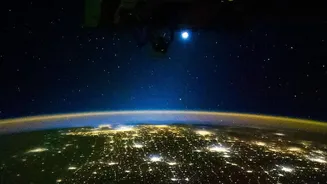
of an orbital data center sounds like science fiction, but the motivations are grounded in real-world constraints. On Earth, data centers are facing immense pressure from soaring energy demands, land scarcity in key markets, and significant water usage for cooling. The rise of artificial intelligence has intensified this, requiring computational power that is straining terrestrial grids. In theory, space offers an elegant solution: constant, abundant solar power without the need for grid connections, and a vacuum that, while presenting its own engineering challenges, eliminates the need for water-based cooling. Companies like SpaceX, Google, and startups such as OrbitsEdge and Starcloud see a future where processing massive datasets, especially for AI and Earth observation, happens 'at the edge'—in orbit, close to where the data is collected. This reduces the time and expense of sending vast amounts of raw data back to Earth.
The Megaconstellation Boom
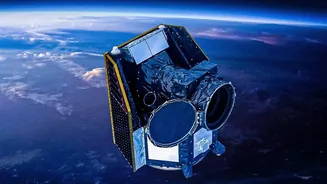
This idea doesn't involve just one or two satellites. We're talking about 'megaconstellations'—interlinked groups of hundreds or even thousands of satellites working in concert. The concept has already been proven by internet providers like SpaceX's Starlink and Amazon's Kuiper project. Now, companies are applying that model to computing. SpaceX has filed plans with the US Federal Communications Commission (FCC) for a staggering one million satellites to form an orbital data center network. Other players, including China's Guowang and startups like Orbital, have proposed constellations numbering in the tens of thousands. These developments are part of a massive acceleration in space activity, driven by cheaper launch costs and the commercialisation of low Earth orbit (LEO).
A Sky Full of Artificial Stars
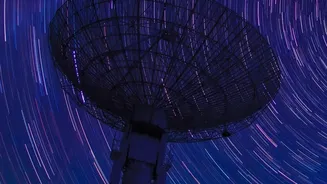
While innovative, these constellations have a significant and controversial side effect: light pollution. The reflective surfaces of thousands of satellites catch the sunlight, creating bright streaks across the night sky. This isn't a new problem—astronomers have been raising alarms since the first Starlink launches—but the scale of the proposed data center fleets would make it exponentially worse. These moving points of light can ruin long-exposure astronomical images, rendering expensive research data useless. The International Astronomical Union (IAU) has warned that the combined glow from existing satellites and space debris may have already increased the overall brightness of the night sky by 10% over natural levels. This interferes not only with professional science but also with humanity's shared cultural heritage of a clear, dark sky.
Astronomers Call for Limits
In response to this growing threat, the scientific community is pushing for regulations. The IAU's Centre for the Protection of the Dark and Quiet Sky has established recommended brightness limits. The goal is for satellites to be no brighter than a visual magnitude of 7, making them effectively invisible to the naked eye. For context, the faintest stars visible in a truly dark sky are around magnitude 6—and the scale is logarithmic, so a satellite at magnitude 1 is over 100 times brighter than one at magnitude 6. Studies show that nearly all satellites in current megaconstellations already exceed the IAU's recommended limit for professional research. While some companies like SpaceX have made efforts to reduce reflectivity with special coatings or sun visors, results have been mixed, and voluntary compliance often falls short when it conflicts with business needs.
The Challenge of Dark Sky Governance
Implementing and enforcing these limits is a complex challenge. Space is a global commons, and there is currently no single international authority with the power to mandate brightness levels for commercial satellites. While bodies like the International Telecommunication Union (ITU) regulate radio frequencies to protect radio astronomy, no equivalent exists for optical light pollution. Some jurisdictions are beginning to act; the proposed EU Space Act, for example, would require operators to have light pollution mitigation plans. However, with companies filing for constellations of up to a million satellites, astronomers argue that a global, coordinated effort is needed to ensure that the pursuit of orbital computing doesn't permanently obscure our view of the cosmos. The debate highlights a fundamental tension between rapid technological innovation and the preservation of a shared natural resource.