



Catching a Planet's Shadow
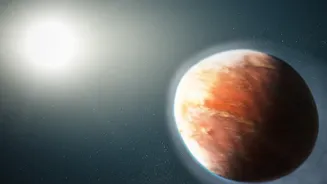
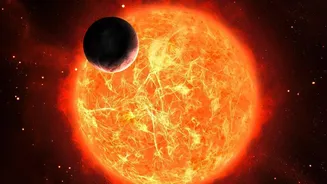
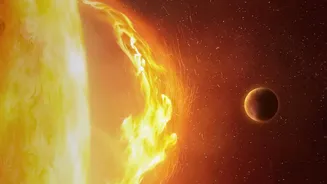
The primary technique for this interstellar investigation sounds deceptively simple: wait for a planet to pass in front of its star. This event, called a 'transit', causes a minuscule dip in the star's brightness. For astronomers, this is the golden moment.
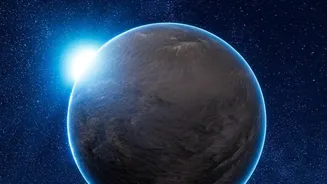
While most of the starlight is blocked by the planet itself, a tiny fraction filters through the planet's atmospheric fringe. This is where the magic happens. The gases in that atmosphere will absorb some of the starlight, and the powerful optics of telescopes like the James Webb Space Telescope (JWST) are sensitive enough to detect these subtle changes.
Decoding the Chemical Barcode
The technique of splitting light into its constituent colours is called spectroscopy. When starlight passes through an exoplanet’s atmosphere, different gas molecules absorb very specific wavelengths, or colours, of that light. This creates a unique pattern of missing light, which scientists can read like a chemical barcode. Water, methane, and carbon dioxide each have a distinct spectral fingerprint. By analyzing which 'bars' are missing from the starlight spectrum after it passes through the atmosphere, astronomers can determine which gases are present, even from light-years away.
The Search for Telltale Gases
A 'biosignature' is a substance or phenomenon that provides evidence of life. In this context, it refers to gases in an atmosphere that are likely produced by living organisms. On Earth, life generates numerous gases, but the most prominent ones that could be detected from afar are oxygen, its byproduct ozone, and methane. Oxygen is highly reactive and would normally disappear from an atmosphere unless it's being constantly replenished, as it is on Earth by photosynthesis. The simultaneous presence of gases that shouldn't coexist, like oxygen and methane which tend to destroy each other, is considered a strong sign of 'disequilibrium'—a potential indicator that a biological process is actively maintaining both.
The Power of the Webb Telescope
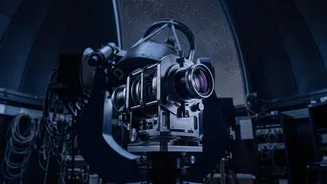
This entire field has been revolutionized by the James Webb Space Telescope. Its massive mirror and extreme sensitivity to infrared light—where many key molecules have strong spectral features—make it the premier instrument for this work. JWST can perform transit spectroscopy with unprecedented precision, allowing it to detect faint signals from the thin atmospheres of smaller, potentially rocky planets. It has already successfully identified molecules like methane and carbon dioxide in exoplanet atmospheres, and even hinted at potential biosignatures like dimethyl sulfide (DMS) on the planet K2-18b, a molecule produced on Earth primarily by marine life.
Ruling Out the Impostors
Finding a potential biosignature is not the same as finding life. A major challenge is ruling out 'false positives'—abiotic, or non-biological, processes that could mimic a sign of life. For example, a planet's atmosphere could build up oxygen if intense ultraviolet light from its star splits water molecules. To increase confidence, scientists look for context. They don't just hunt for a single 'silver bullet' gas but for a suite of molecules. They also create complex models to see if the planet's geology or its star's activity could explain the atmospheric composition without invoking life. A potential detection of two gases could even be caused by an exoplanet and a moon, each with a different atmosphere, contaminating the signal.