





A Cosmic Mystery in Crimson
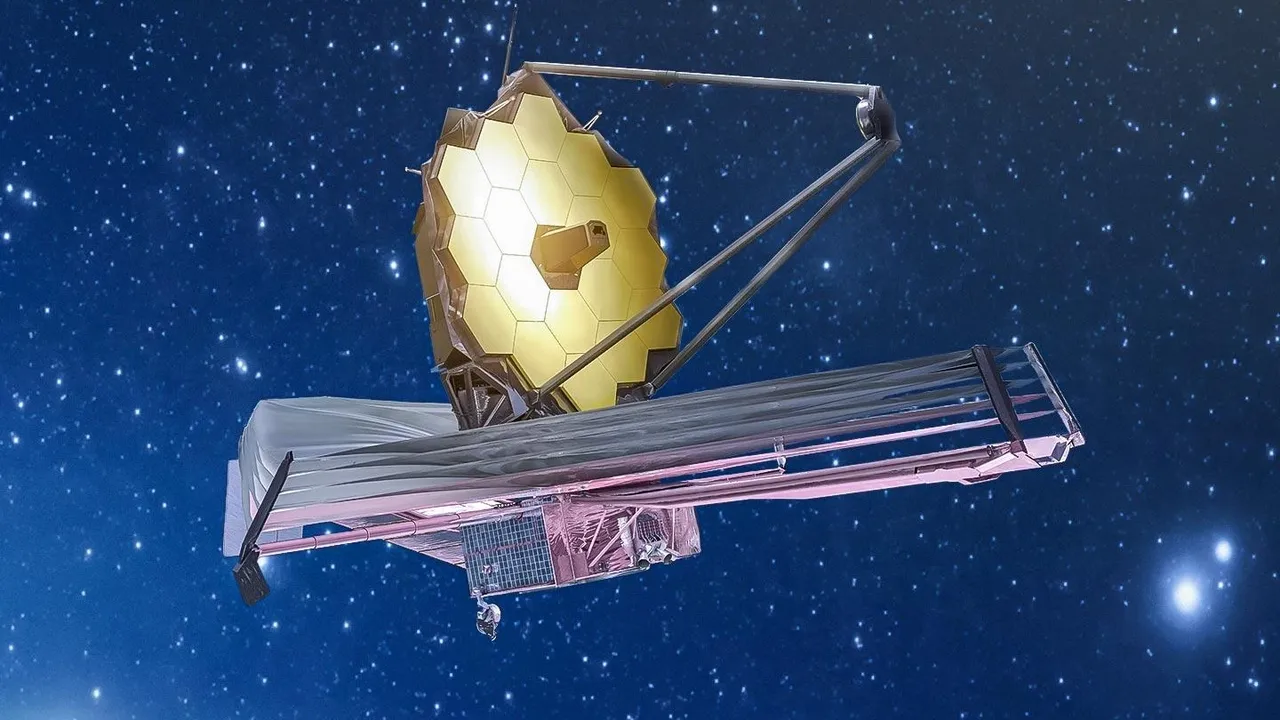
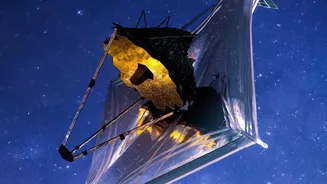
Since it began operations, the James Webb Space Telescope (JWST) has been rewriting our understanding of the early universe. Among its most puzzling discoveries is a new class of object officially known as Little Red Dots, or LRDs. These objects are extremely
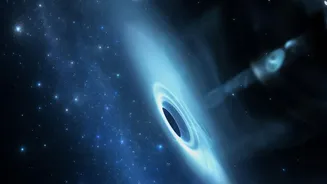
distant, meaning we see them as they were over 12 billion years ago, when the universe was in its infancy. They are compact, intensely bright, and, as their name suggests, distinctly red. Astronomers have cataloged hundreds of them, all hailing from a time just after the cosmic dawn. The central question has been, what are they? Theories have ranged from hyper-luminous, dust-shrouded galaxies packed with newborn stars to a completely new type of object: ravenous supermassive black holes actively swallowing matter. While many LRDs showed signs of hosting black holes, they didn't quite match the profile of similar objects in our galactic neighborhood, adding to the enigma.
The Clue Hidden in a Cactus
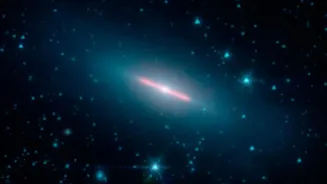
The breakthrough didn't come from looking deeper into the past, but by studying something closer to home. A team of researchers turned Webb’s attention to a spiral galaxy nicknamed “Saguaro,” named for its resemblance to the iconic cactus. This galaxy is much closer to us than the LRDs, but its core shared intriguing similarities. At its heart, Saguaro hosts an active, supermassive black hole that is heavily obscured by gas and dust, making its nucleus appear compact and reddish—much like an LRD. This gave the scientists an idea. What if the LRDs weren't just dots, but the only visible part of something much larger? They decided to run a clever simulation.
An Intergalactic Disappearing Act
The team took their detailed image of the Saguaro galaxy and digitally “moved” it across cosmic time. They simulated what Saguaro would look like if it were located at the same extreme distance as the LRDs from the early universe. The result was astonishing. The sprawling spiral arms and the faint, outer halo of the galaxy completely vanished. Even for the powerful JWST, the light from these structures was just too faint to be detected at such an immense distance. All that remained visible was the bright, compact, red nucleus. The Saguaro galaxy, in effect, had transformed into a Little Red Dot. The experiment provided a stunningly simple explanation: the LRDs might not be exotic, isolated objects after all. Instead, they could be the overwhelmingly bright centers of massive host galaxies that are simply hidden from our view by cosmic distance.
Rewriting the First Chapter of Galaxies
This discovery has profound implications for how we understand the evolution of galaxies. It suggests an observational bias has been at play; we've been seeing the tip of the iceberg without realizing the iceberg was there. These LRDs likely represent a temporary but crucial phase in a galaxy's life, when its central supermassive black hole is growing at a furious rate. This intense activity makes the core outshine the rest of the galaxy, creating the 'dot' appearance. This also helps solve another puzzle: why LRDs seem to be common in the early universe but disappear over time. They don't actually vanish. Instead, as the black hole's feeding frenzy subsides, the bright nucleus dims, allowing the rest of the host galaxy to become visible. The Little Red Dot simply evolves into a more recognizable galaxy, its youthful, energetic phase a memory written in the light traveling across billions of years to reach us.