
A Universe Believed to Be Perfect
Before 1604, the dominant view of the cosmos in Europe came from the ancient Greek philosophers Aristotle and Ptolemy. They taught that Earth was the centre of the universe, and everything beyond the Moon existed in a heavenly realm of perfection. The stars
were fixed to crystalline spheres, made of a perfect, unchanging substance called aether or quintessence. According to this model, which held for over 1,500 years, nothing new could ever appear in the heavens, and nothing old could ever fade away. This wasn't just a scientific theory; it was a deeply ingrained philosophical and theological worldview. The celestial realm was eternal and immutable, a stark contrast to the corruptible, ever-changing world on Earth.
A 'New Star' Appears in the Sky
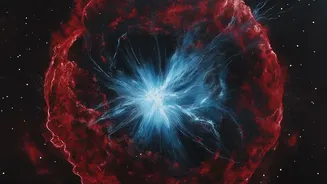
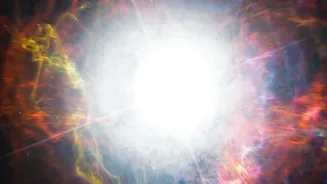
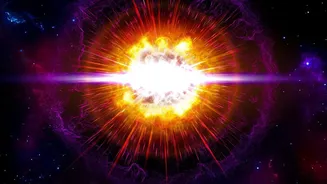
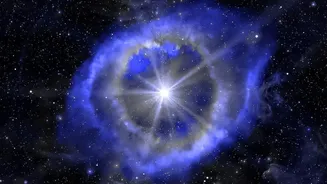
In early October 1604, observers in Italy, China, and Korea noted the appearance of a 'new star' (or 'stella nova') in the constellation Ophiuchus, the serpent-bearer. This object, which we now know as Supernova 1604 (SN 1604), grew so bright that it outshone every star in the night sky and even the planet Jupiter. For over three weeks, it was visible during the daytime. Its appearance was a direct and public contradiction of the Aristotelian model. How could a new object appear in the supposedly perfect and unchanging heavens? The event occurred just 32 years after another supernova in 1572, observed by Tycho Brahe, had already begun to cast doubt on the old cosmology. The appearance of a second new star in a single generation intensified the debate.
Johannes Kepler's Crucial Observations
Though he wasn't the first to see it, the supernova became inextricably linked with German astronomer Johannes Kepler, who began his meticulous study on October 17, 1604. Kepler tracked the object for over a year until it faded from view, documenting its brightness and position with remarkable precision for the pre-telescope era. Most importantly, he attempted to measure its parallax—the apparent shift in its position against the background stars as the Earth moved. He found no discernible parallax, which was a critical piece of evidence. This proved the 'new star' was not a nearby atmospheric phenomenon, like a comet, but was located far beyond the Moon in the realm of the 'fixed' stars. His detailed findings were published in his 1606 book, 'De Stella Nova in Pede Serpentarii' (On the New Star in the Foot of the Serpent Bearer).
Shattering the Crystalline Spheres
Kepler's proof that the supernova was a distant celestial event was a hammer blow to the Aristotelian cosmos. An object that appeared and then disappeared in the supposedly eternal heavens demonstrated that the celestial realm was, in fact, subject to change. This idea of a 'mutable' heaven was revolutionary and provided powerful evidence for a new generation of astronomers, including Galileo Galilei, who were challenging the old geocentric model. If the heavens could change, then the core philosophical premise of the old model was flawed. The supernova didn't prove the Earth revolved around the Sun on its own, but it fatally undermined the authority of the ancient ideas that stood in the way of the Copernican heliocentric theory.
The Supernova's Legacy Today
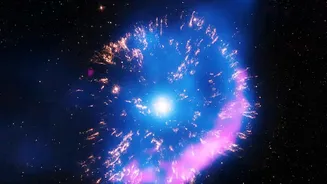
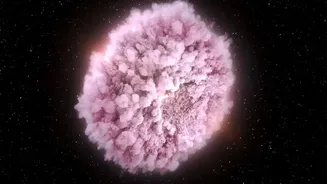
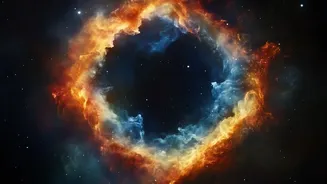
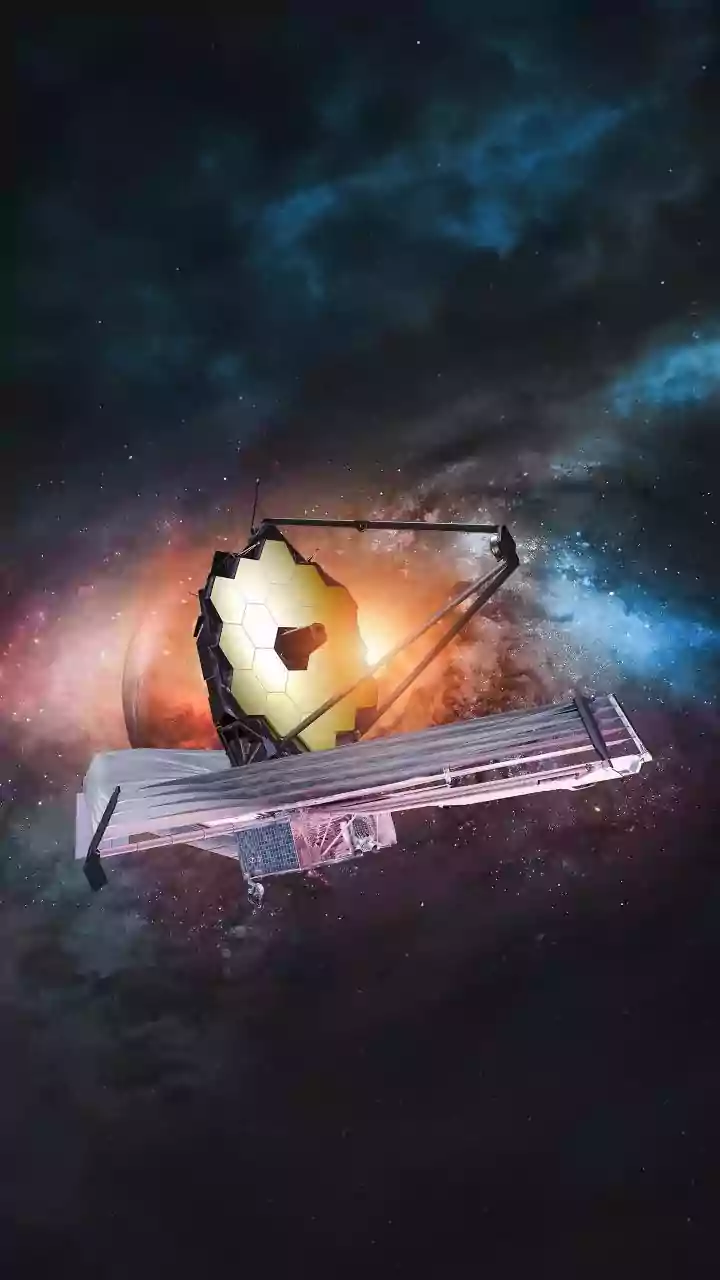
SN 1604 remains the most recent supernova to have been definitively observed within our own Milky Way galaxy with the naked eye. Modern astronomers, using powerful tools like the Chandra X-ray Observatory and the Hubble Space Telescope, have identified it as a Type Ia supernova. This type of explosion occurs when a dense, compact star called a white dwarf pulls material from a companion star until it reaches a critical mass and detonates in a cataclysmic thermonuclear explosion. The expanding cloud of debris from the explosion, known as Kepler's Supernova Remnant, is still studied today. Located about 20,000 light-years from Earth, its expanding gas and dust provide vital clues about the mechanics of supernovae and the distribution of heavy elements throughout the universe.